


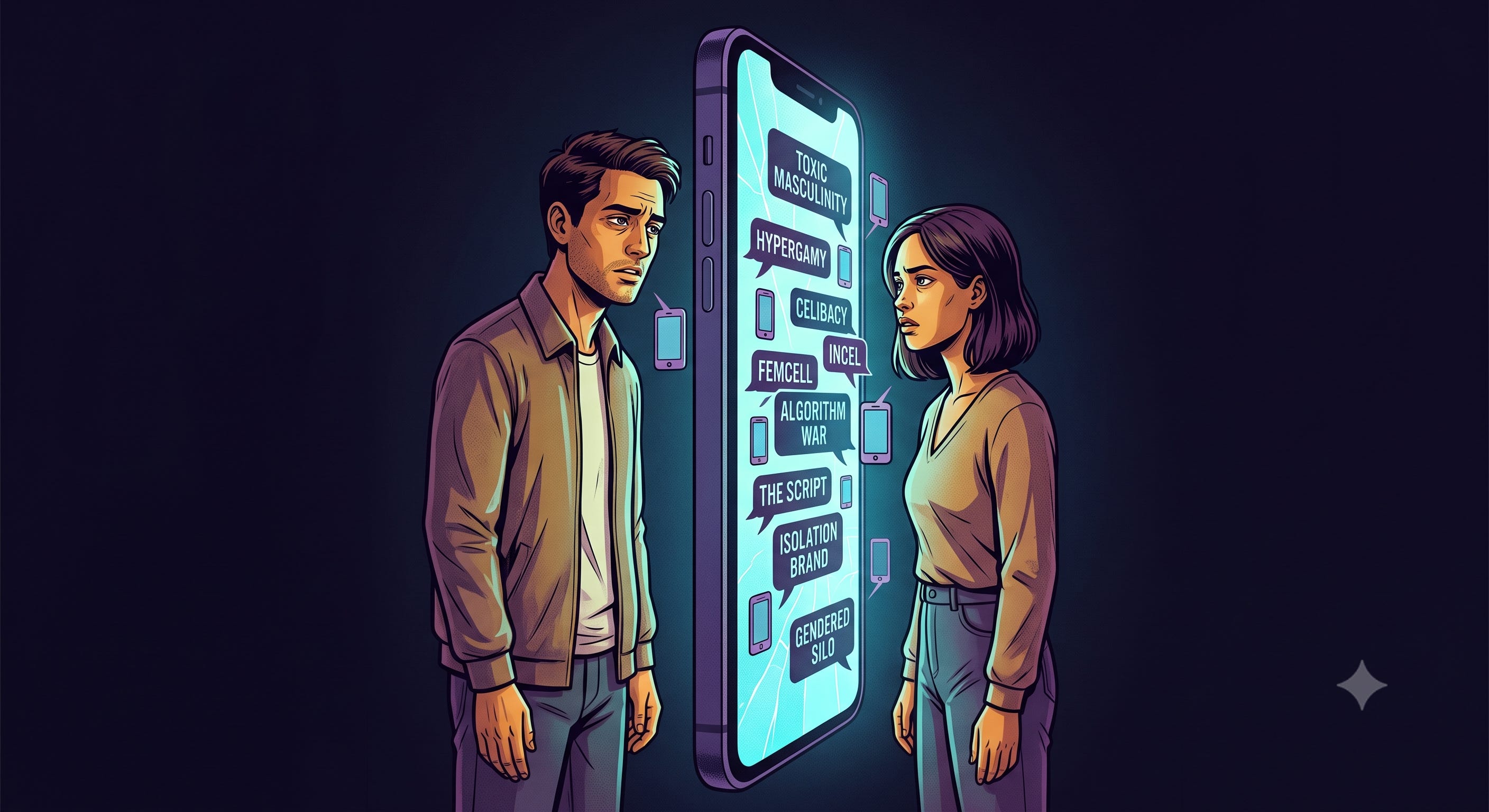
Another week, another entry in the heteropessimism files. Although these things are starting to all sound the same, are arriving at a kind of consensus about what is causing heteropessimism, they each bring a new little horror; in this case the phrase loneliness influencer.
One reason I’m so fascinated by heteropessimism is that it’s become my go-to case study for trying to understand how “real” social discourses are. My working understanding of this is that they are both real and not-real at the same time: vastly overstated, exaggerated, performed online for attention and engagement, because most content is just copying other people’s content. As the Times ladies point out, social media encourages people to put a label, an “ism,” an identity, a brand on their life choices, which may sometimes be a lack of life choices in disguise. But someone still has to make loneliness and heteropessimism content, and someone has to watch it or engage with it, which suggests it strikes some kind of chord or offers some way to self-interpret that resonates with people.
I think a lot of reasonably-adjusted people treat “the discourse” as a kind of semi-fictional universe that overlays reality, which they refer to like it’s a thing or at least a source of conversation and humor, even if they don’t actually believe the things that are said in it or practice them in their real lives. I personally don’t know anyone who believes or practices heteropessimism. But I have heard tell of people who are TikTok-brained into believing completely fantastical things about what other people want (the impossible standards they have to meet to ever be loved or fucked), and/or are completely paralyzed by internet-driven anxiety about dangers whose probability in the real world is basically zero. Both types are in abundant evidence on Reddit.
The going explanations for heteropessimism include:
A sequence of unusual historical experiences: Social media > Trump era/Me Too > pandemic
Discursive gender wars: Young men and women (but not only young!) being siloed into gendered discourse universes that are increasingly skeptical of/hostile to the other gender and, more importantly, rife with fantastical notions about what the other gender is like or wants
The anti-social option: Digital simulacra of social/sexual experiences becoming widely available and satisfying enough that accessing the real thing seems overwhelming/risky by comparison and loses out in a cost-benefit analysis
Class/lifestyle inflation: Social media-addled notions that life cycles (jobs, relationships, etc) are supposed to happen according to a predetermined script1 in which key life moments/turning points are supposed to be summations, spectacles of achievement and content creation that mimic the luxurious lives of celebrities and internet personalities, as opposed to just normal steps on the road of life that may happen in different orders for different people, or have to be endured with, like, an average amount of money. A relatively normal-for-2026 version of this would be something like, I have to spend my 20s getting a perfect body or creating a passive income stream so I don’t have time to date, and crazy-even-for-2026 versions would be things like I can’t get married until I can have an Instagram wedding that costs $100,000 or I can’t have a twink boyfriend until I can afford to fly him around the world.
A summary of all of that would be something like: Heteropessimism is an internet-induced form of gender conflict, social anxiety and life paralysis that is both shaped by and retrofitted with ideological explanations.
Why is there no homopessimism?
In principle all of these factors except for the crucial one—gender wars—would apply to gay men as well as straight people. Which perhaps tells us right there, without any thought at all, why there’s no homopessimism: the core of heteropessimism is a paranoid, imaginary gender conflict, which simply doesn’t apply to us. But the case of gay men is more interesting than that, because it’s one where, without the dimension of gender difference, some of the same structural features may actually work the other way.
The crucial one of these is what I called the “anti-social option” above. Gay men have abundant anti-social options, if we can really call them that: There are rivers of gay porn, nearly infinite numbers of OnlyFans creators offering custom videos, apps like Grindr, Sniffies, and Snapchat on which one can trade photos and videos and have digital sexual experiences without ever meeting anyone in real life. Have those reduced the amount of real-life gay sex? Possibly! Probably? Or maybe they have just changed what people jerk off to, or the amount they jerk off, and left the amount real-life sex relatively constant.2 There is a very loud contingent of gaycels on Reddit and Twitter who openly avow living a completely internet-driven sex life, but I doubt their numbers are greater than any past era; they are just now able to constitute themselves as a visible social group in a way previously unavailable to the anxious, the socially awkward, and others who take odd comfort in imagining themselves to be unfuckable.
That being said, the interesting fact is that the very same factors that have driven men and women apart and created an anxious distance from the real world have, paradoxically, reconnected gay men with the real world. This is one of those cases—maybe they are more common for straight people than I realize, I can’t be bothered to know—where social media has actually reinvigorated some physical space or in-person practice that recently seemed to be obsolete. And this is where we come to an even hotter take, which is that OnlyFans saved a certain historic gay sex culture by moving away from corny, scripted studio porn scenes toward images of real-life gay guys doing real-world things.
A lot of OnlyFans content is produced by a jetsetting global class of younger hot guys who get Botox and do steroids, rent mansions and film “collabs” in stereotypical places like Fire Island, a fact that has generated no small amount of populist freakout and backlash (see below). But just as not-rich guys with normal bodies manage to go to Fire Island, relatively normal-bodied, non-Prince-Charming-looking guys also make OnlyFans porn and get large followings.3 They make videos of themselves doing gay subcultural things that used to be shrouded behind skeevy unmarked storefronts and otherwise hidden from view: fucking in club bathrooms and at sex parties, cruising outdoors and in public places, waiting “ass up” in hotel rooms, and a whole range of niche and kink practices. These illustrate the variety of gay sexual practices and the fact that they are not the exclusive purview of a narrow slice of privileged gay men or ultra-hot porn stars. Every one of these things is its own genre of OnlyFans porn, which has absolutely exploded interest in doing those things in the real world. As in, I’ll say it, I know a large number of normal gay guys of all types who regularly do these things offline, all of whom have otherwise normal, non-pathological lives, friend groups, and even boyfriends. (Last year’s “gay sluttiness” reporting and the Penn Station cruising sting are just downstream of that.)
I don’t know, maybe something about the male brain pushes us toward risk or makes us feel intensely left out of a group of men doing something that looks so fun. But for Gen Z gay guys, and even for me, as a chronologically Gen Z gay guy, I think it’s crucial that the dissemination of OnlyFans clips on Twitter made it possible to do a very Gen Z type of thing: to preview an experience digitally from beginning to end before engaging in it. In this particular case, social media content actually allays social anxiety, or at least makes an experience look so accessible and enticing that one feels the agency to overcome social anxiety. Now, all of a sudden, all of these gay sexual practices that used to be seen as outmoded and “dying” as gay bars closed and life moved online, have to some extent come back to life. Generationally out of character, Gen Z gay guys have an unusually digitally mediated relationship to sex and have used that as a way to access in-person, real-life sexual practices and reinvigorate physical gay spaces.
Now for the massive asterisk. A lot of gay guys hate this porny sex stuff and feel like it is imposed on them as some kind of “dominant” gay culture, or a default of gay representation. A lot of the backlash comes from the Twitter and Reddit gaycels, but I imagine also from other gay guys who just find all this a bit ridiculous and off-putting. They may or may not dress it up in class critique or woke/privilege critique, which has at least a grain of truth to it even if it is often ignorant of what the supposedly “privileged” gays are like. (Or, specifically, the actual variety of gay guys who do the things that supposedly put one in the “privileged” bucket.) These dissenting gay guys might hook up on Grindr or have boyfriends, or have gay friend groups who play board games and never go to clubs. To be clear, I’m not painting them as somehow marginal or outsiders to a single legitimate “gay culture,” they are also gay culture, perhaps even its dominant form. The majority of them, I think, don’t really care what other types of gay guys do or feel any particular way about it. But a significant subset of them are very vocal about their distaste for and alienation from the porn culture, an alienation that gives rise to all of the Twitter slop discourses about friend group photos, muscle gays, body standards, open relationships vs. monogamy, and how “gay culture” is shallow and an outgrowth of our collective trauma and damage, etc.
None of that is new: Even in the days of Dancer from the Dance, the circuit gays were a subset of gay men, of which Holleran’s novel was to some extent a social critique. Discos and promiscuity always provoked backlash and battles between subcultures of gay men, as well as self-hatred among the circuit gays about their own practices, self-hatred that sometimes leads even them—the so-called “privileged,” “dominant” type of gay guy—to take up the simplistic binaries of the Twitter haters and the slop discourse.4 There have always been feminist gay men trying to chalk up everything deplorable about gay male culture to a toxic investment in masculinity. There have always been therapeutic discourses among gay men that try to “essentialize” their behaviors and practices in relation to the trauma of the closet or whatever. My point is, social media has actually not changed this much: it has created new digital versions of these old divides, but it hasn’t necessarily widened or intensified them. In a way, it has reconstituted the themes and fault lines of a gay culture of the past.
With asterisks that big and so much sad slop discourse among gay men, it might be going too far to say there is no such thing as homopessimism. There are certainly faux-transgressive gay intellectual types trying to start homopessimist discourses, another thing that has been with us since even before the internet. But thankfully no one asked them, and broadly speaking, my sense is that gay men have somewhat uniquely resisted the anti-sociality of the social media age, not by rejecting social media but by taking it up as a tool to mediate the gap between content and reality, to overcome, to a certain extent, the hypermediated paralysis that characterizes heteropessimism. And the simplest reason, of course, is that whatever divides between gay men social media can create, the one thing it can’t create is a gender war.
The amount of social media content that presents an idealized recipe for exactly how your life is supposed to happen, and how you are damaged/traumatized/left out if it doesn’t, truly boggles the mind and is, I think, a legitimate social crisis.
We should put to rest the idea that porn/jerking off and digital sexuality are somehow in a zero-sum relationship to real-life sex. Contra the “no fap” morons, the male libido is an inexhaustible resource. In my experience, in horny periods I am more likely to jerk off a lot and have more real-life sex, while in busy/not-horny periods I may not do either. And the truism is true: one has a lot more sex, of all the kinds, in a relationship than without one.
As Andrew Holleran wrote in 1979: “One has to be rich and beautiful to go to Fire Island,” a friend writes me from Oregon. “Nonsense,” I reply. One has to be rich or beautiful, I am tempted to add; but this, if witty, would be untrue. The Pines is composed largely of people who are neither rich nor beautiful…”
Some of the gays in what the internet considers the “privileged” category (hot/traveling/having friends and doing things in the real world/having promiscuous sex/etc) occasionally engage in a pensive way with this sort of “sad gay slop” that makes a huge, AI-generated deal out of gay loneliness and alienation. But more often, according to my in-progress research on “muscle gay” discourse cycles on Twitter, they enjoy the hatred and actually fan it/amplify it beyond its real reach. In a sad/hilarious way, the “muscle gay” and the “gaycel” have constituted each other in Twitter discourse in a way that surely offers certain narcissistic pleasures to each type despite everyone’s performative exhaustion with the “debate.”
I feel dirty that I read and wrote one word about this on Tisha B'Av (fortunately the Times did not print the linked article today and I predict that I get to worry about it on Sunday. When I checked I did get an earful of Ross Douthat talking about Richard Hanania's new book to which I can only say that Hanania getting any mainstream contract to publish a book is an index of our times) but a) my subculture is not heteropessimistic at all b) the culture index represented by the Hugos/Lodestars after having had no idea what to do with heterosexual sex and romance immediately after #MeToo has now figured it out with male romantic heroes who could easily be the heroes of their own book (and in Alix E. Harrow's "The Everlasting" we don't need that qualification because without the hero there's no story) c) I would trace back the thread to the idea that being sex positive means having a lot of meaningless sex. If sex is meant to be meaningless and performed for some ideological bona fides then younger people are justified in finding things that are more personally meaningful for them.
probably because there isn't a media apparatus bashing homosexuality the way there is for heterosexuality