


Entering 2025 on a “vibe shift,” it could be difficult to tell if the shadows that fell over gay world this year were alarming or a little ridiculous. Busily working toward the Führer in the first half of the year, American corporations withdrew their support for Pride events across the country, which correspondingly shrank or were canceled altogether. At World Pride in D.C., headline sponsor Marriott insisted that already-produced signage for the event be reprinted without the term “presented by,” even as they maintained their financial support. Across the information economy, DEI commitments disappeared from corporate websites even as, in some cases, they were forcefully reiterated internally. The Supreme Court unnervingly heard another case by the gay-rights villain Kim Davis, but everyone agreed it had no chance of going anywhere in the first place.
Even the standout moments in gay discourse blurred the silly and the sinister. In mid-summer, the New York culture magazines took a sudden interest in gay sex. The New Yorker led the way in July with a profile of the cruising app Sniffies. The Cut followed in August with a report on “peak gay sluttiness,” which framed the current renaissance of gay promiscuity—Sniffies, again, was front and center, along with the major and minor drugs that enhance sluttiness—as a FOMO-inducing cultural trend. “Everyone is doing drugs. Everyone is getting laid more than you,” declared the author, a gay man at least adjacent to the scene. “It’s no longer gay culture that has captured the zeitgeist, but gay sex.”
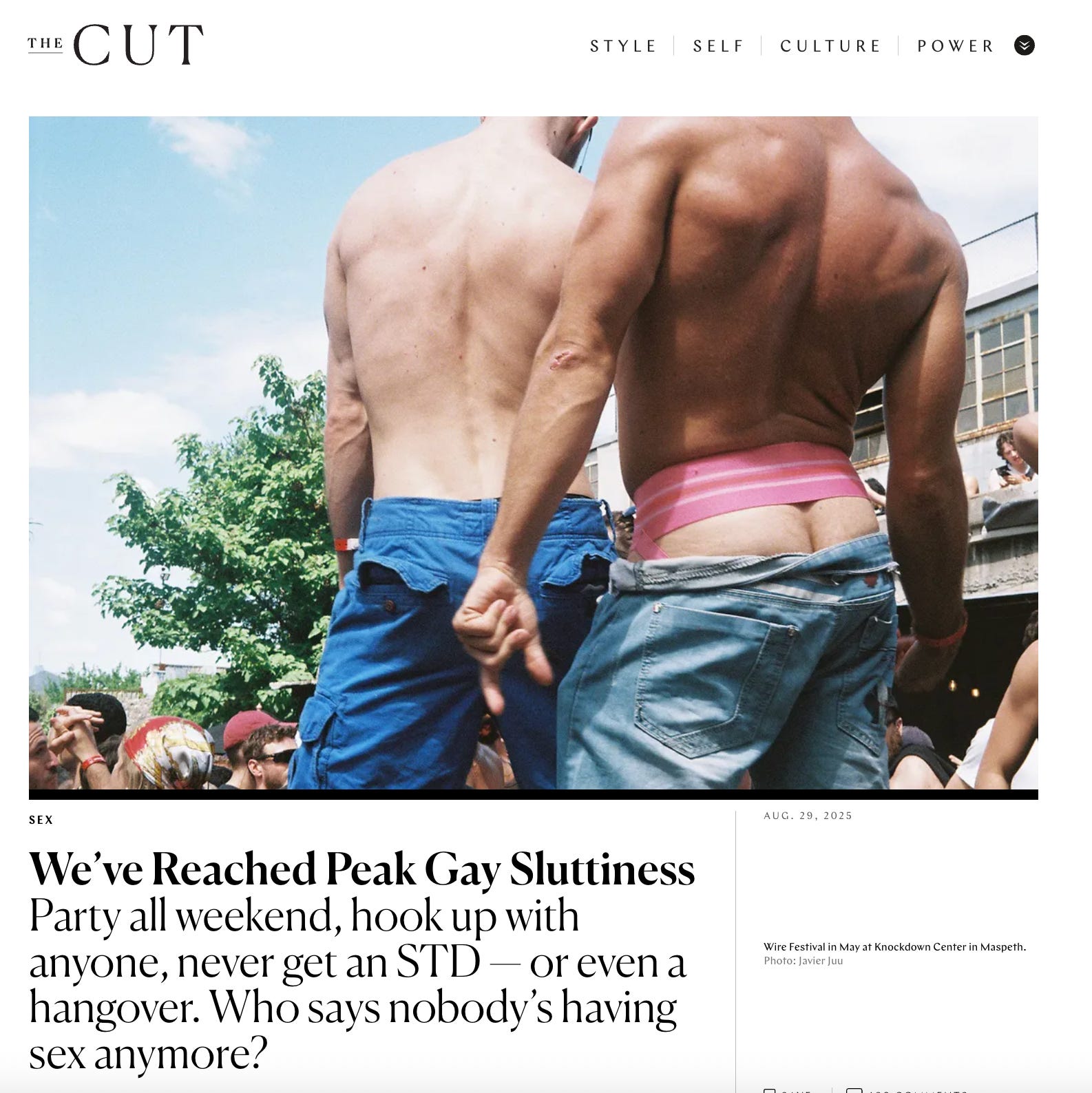
“Peak gay sluttiness” was polarizing across a number of incommensurable axes. Many of my text correspondents reported a mixture of amusement and embarrassment at what we take for granted being treated as a trend story. (“I hate everything about this article,” one said. “Or maybe I hate our lives.”) Some thought it exaggerated the dangers of GHB, while others thought it was too flippant about them. Some had quibbles that sounded, to my ear, like internecine squabbles over which drugs and parties—and by extension, which type of gays—were better. Nearly everyone found the rah-rah tone a little disconcerting. To the article’s credit, it did reveal a thirst for this type of debate, and only highly fragmented ways to have it.
Thus saith The Cut: “In a year of wild partying … it is easy enough to ignore the country’s swing to conservatism and mute the feed quickly filling with tradwives.” But less than a month after the culture mags uncovered the gay sex zeitgeist, the American moment showed the other side of its face: Amtrak police in New York launched a 1950s-style entrapment scheme and began mass-arresting gay men for cruising in the restrooms at Penn Station. Many had their trumped-up charges expunged, while others were handed over to ICE for deportation. It is impossible, of course, to establish any direct correlation, but that didn’t stop people from speculating; we’d taken the bait on straight magazines airing our degenerate proclivities only for the baiting to turn a bit too literal.
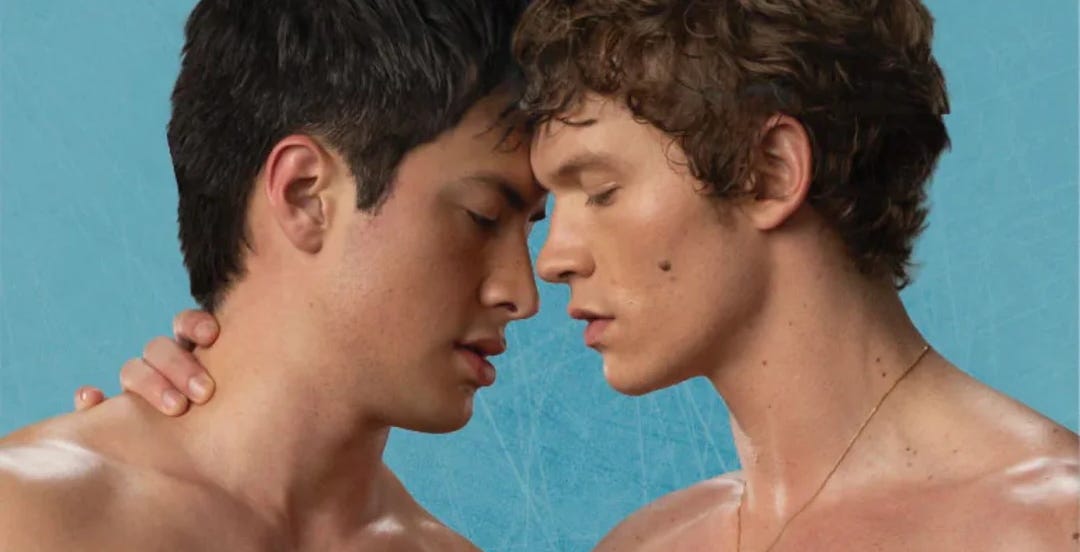
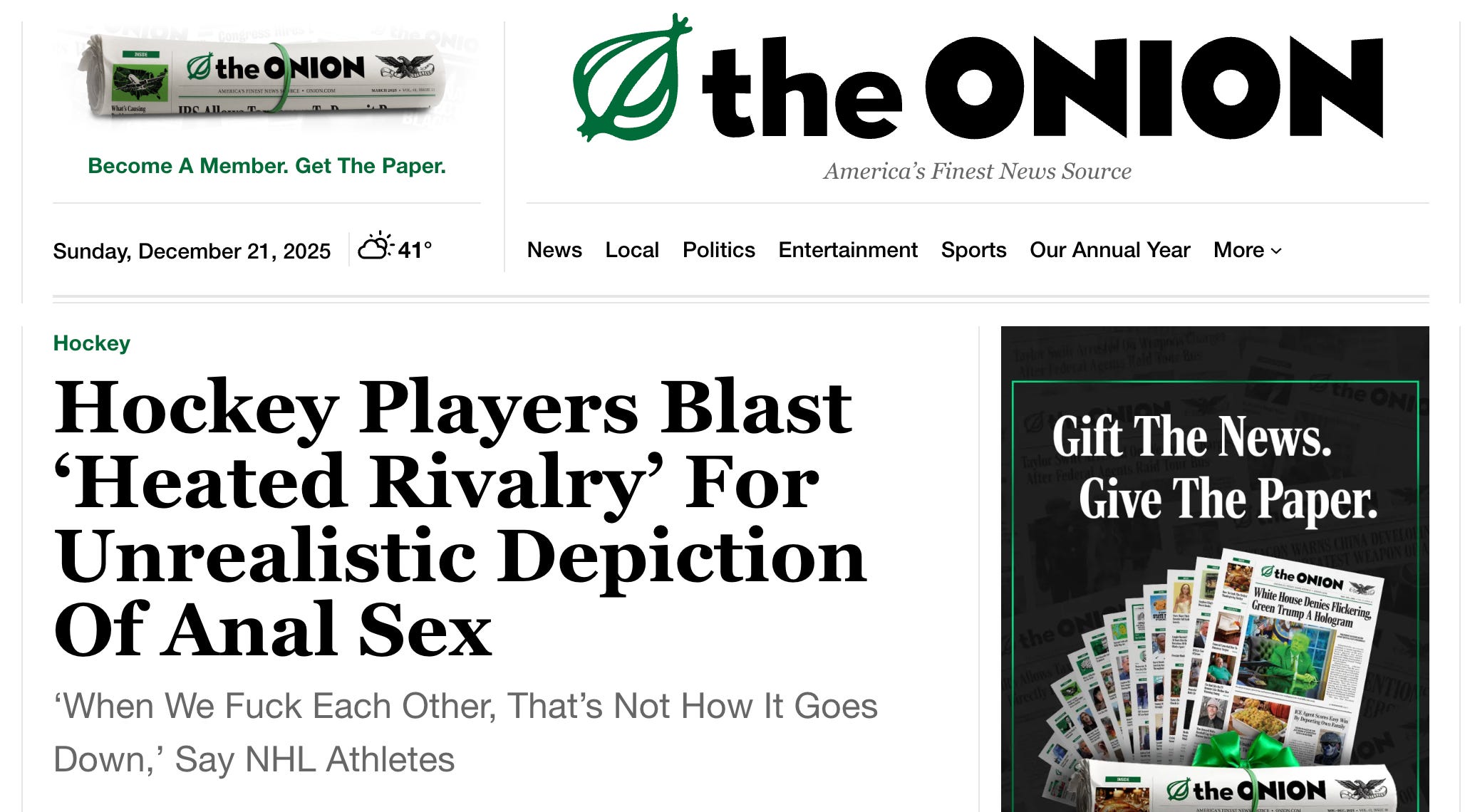
Especially after that grim turn of events, the claim that gay sex had “captured the zeitgeist” seemed wishful at best. But now, in December, there is, to put it mildly, new evidence to be admitted. Over the past couple of months, Heated Rivalry, a TV series based on a series of steamy “M/M romance” novels, rode a groundswell of online enthusiasm to a pickup by HBO and a siege of the digital public sphere. It follows Shane Hollander (Hudson Williams) and Ilya Rozanov (Connor Storrie) young hockey stars who, before they’re even signed into the NHL, become obsessed with each other and begin secretly fucking every time they’re in the same city even as league marketing paints them as implacable enemies. There are three sex scenes in the first episode and almost as many in each subsequent one. To say that Heated Rivalry is an engagement juggernaut would be an understatement: in addition to the rivers of fan art and edits and reaction TikToks, every major American publication has cashed in by dissecting its cultural appeal (Harper’s Bazaar, NPR, everybody); fawning over its stars’ sexual chemistry (Vanity Fair, GQ, everybody), ass workouts (Vogue) and skin care routines (The Cut again); reviewing its sex scenes (Slate, Vulture, Out); or making fun of the whole thing (The Onion).

I discovered the show the same way everyone else did: via the sweaty, steamy clips that started circulating on Twitter shortly before the premiere. I was previously in the dark despite loving a boy who reads M/M sports romances, had read this particular M/M sports romance years ago, and had also long known the show was in the works. (“Why didn’t you tell me there was a gay sex hockey show coming out?” I asked. “I did,” he said, “but you never listen to anything I say.”) We watched the first episode with hands spontaneously wandering into sweatpants, which I soon learned was a widespread practice and on the tamer end of the spectrum; I’m told that the irrepressible New York gays circulated an event on Sniffies bearing the title “Heated Rivalry Watch Party + Orgy.”
Early adoption may be a gay specialty, but we’re relative latecomers to the Heated Rivalry phenomenon. Director Jacob Tierney even seems to have counted on the particular affinity of our kind for bandwagons and cultural moments. “I always said,” he told Teen Vogue, “Once you film this, gay men will watch it, but we’ll watch anything with gay men in it. We’re not wildly discerning in that way.” Tierney is gay, but his source material is steeped in the horny female internet; written by a Canadian author named Rachel Reid, Heated Rivalry originated as smutty Marvel fanfiction before it evolved into a “spicy hockey romance.”
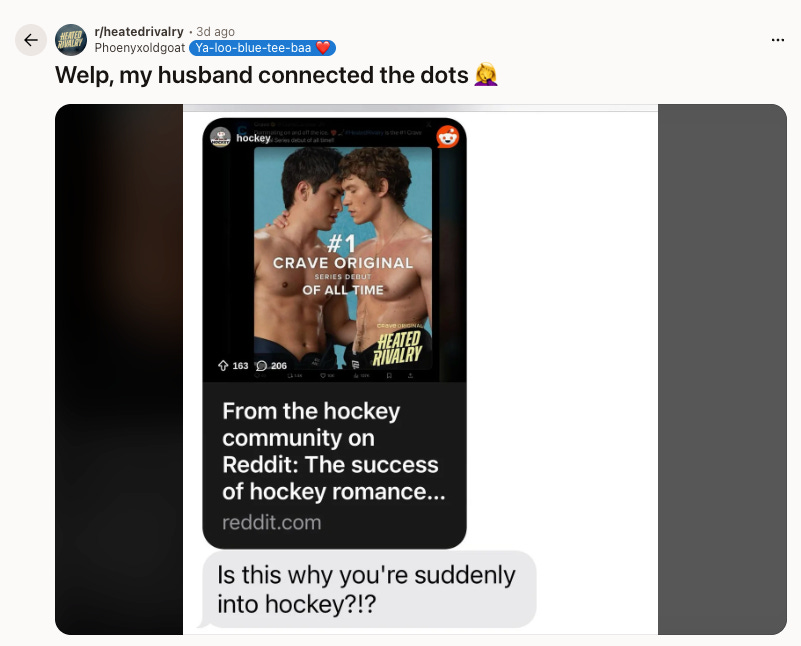
Hockey romance is a sub-subgenre of “sports romance,” a subgenre of “M/M” romance, or gay romances predominantly written by women for other women. The sub-subgenre has, the New York Times informs us, boosted the historically low popularity of hockey in Australia and led to real-world clashes between the NHL and its readers, who have applied the modern fandom repertoires of “stanning” and “shipping” to real NHL players. A frankly uncountable number of women on Twitter, or people who claim to be women, or bots, admit to screaming “KISS EACH OTHER!” at hockey games. When the wife of Seattle Kraken player Alex Wennberg complained on Instagram about this fan behavior—which included the admittedly brilliant chant “KRAK MY BACK”—her account was flooded with harassment. Updated Rule 34: if it can be imagined, there are insane stans of it.
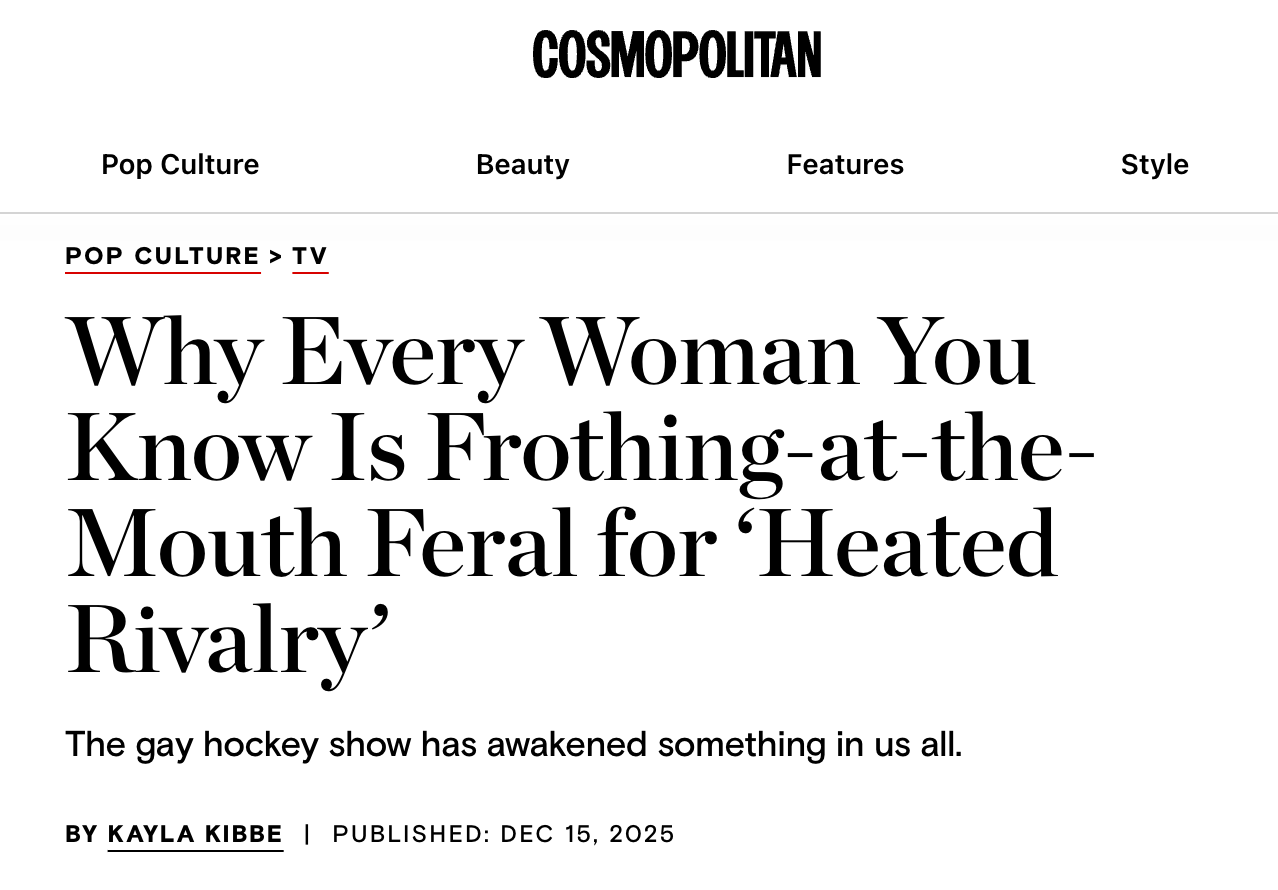
This origin story sheds a lot of light on the absolute explosion of gay sex discourse in which gay men are kind of a sideshow. A great deal of that is devoted to dissecting, as Cosmopolitan’s headline helpfully summarizes, “Why Every Woman You Know is Frothing-At-the-Mouth-Feral for Heated Rivalry.” (The Carrie Bradshaw voiceover writes itself: “What I had to find out was why the hottest women in New York were all suddenly obsessed with gay sex!”) No gay journalist has thus far rivaled Cosmo’s cultural sociology, which, surveying a range of women, chalks up the fascination with hockey players fucking to a fantasy escape from the structures and disappointments of hetero sex—in other words, to something like heteropessimism. Gays are left to once again talk to each other via the pages of New York, from whence the gay comedian and I Love LA actor Jordan Firstman launched his attack on Heated Rivalry. “I’m sorry, I watched those first two episodes and it’s just not gay,” he complained. “It’s not how gay people fuck. … I go to art to be confronted and to think, but a lot of people just want entertainment or to see two straight hockey players pretending to be gay and fucking.”
Firstman is far from the only gay man to react with indifference, but the skeptics seem to be in the distinct minority. Scattered across the broader zeitgeist there are distinctively gay responses to Heated Rivalry. First and most importantly is the gut level: it’s competent, entertaining smut. I’m typically not a reader of romance novels of any sort unless you count Jane Austen or Sally Rooney (which, why not?), and I was charmed by the book’s formal similarity to online gay erotica. The first half is organized around snappy, no-frills sex scenes that keep characterization and plot to a minimum and lean into the classic gay fantasy of team sports and locker rooms. Before I thought about it much, I also instinctively related to a relationship that builds from repeat hookups. As David Mack wrote in Slate, “For many gay men, it’s fucking first that can later turn into feelings, not the other way around.”
There’s another reaction promoted by Tierney and widely echoed in the social media discourse. “I’m thrilled, as a queer person, to be putting out a romance into the world that is not punishing and that is not full of dead, miserable gay characters,” he said. “This is a gay story where no one dies of AIDS, and no one goes back to their wives.” That’s probably a reference to Fellow Travelers, but it’s been quite a while since that description fit gay TV in general; Heated Rivalry is nowhere near the first show to feature nuanced depictions of gay men or tragedy-free gay romance. But if we put Tierney’s comments in the context of the fujo stanning of the book and show, which at its most extreme equates romance representation with political activism, it becomes clear what he’s suggesting: that “positive representation” equals uncomplicated happy endings, equal opportunity fulfillment of romance-novel tropes. These, naturally, don’t have much to do with a story being authentically gay in the sense of being informed by the lives most contemporary gay men live, or the stories they’ve told about themselves in their own literature. What’s celebrated as a great leap forward here is actually just gay trappings used to re-energize timeless romance tropes of hidden, thwarted passion.
But the NHL is super homophobic! There’s still never been an out gay hockey player! These widespread defenses of the show’s authenticity are correct in a narrowly factual sense. But one possible reading of Heated Rivalry’s NHL setting is as a deliberate choice of anachronistically homophobic terrain for the purpose of retelling one narrow, extremely familiar part of gay experience: the path from isolation to coming out. As Jim Downs argued in a thoughtful Slate essay, this is gay storytelling stuck in the past, arriving over and over at square one. “Gay narratives still tend to treat confession as the plot—the moment when life supposedly begins. But for most people, coming out isn’t an ending or a climax. It’s the threshold.”
If there’s an identitarian critique of Heated Rivalry, it’s not the skin-deep cultural appropriation lens that tediously obsesses over who is allowed to tell which stories. Rachel Reid is perfectly capable of writing fun, competent gay smut; her hockey romances are better than some of the ones written by gay men. But surrendering gay sex to a general cultural zeitgeist—content for female fandoms, an escape from heteropessimism, a trend story for straight magazines—has its ambivalences. It may mean gay stories never advance much beyond their most familiar and culturally legible dimensions, even if they have happy endings instead of deaths from AIDS. The discourse they inspire raises lots of questions, but not necessarily our questions. That’s nobody’s fault, exactly; no individual gay writer or producer can single-handedly change the structural conditions that have attenuated the cultural spaces for those questions. But it’s worth asking: do we want to explore our lives in conversation with each other, or are we content with the tropes of the zeitgeist?
Great post. Been ruminating on it for a while and have some thoughts:
(1) At some point this merely becomes the curse of being a minority, no? I keep on substituting "gay" for other minorities and finding the overall points seems to apply to them, too. For example, popular stories wont convey the "authentic" mathematician's perspective because the number of people actually able to understand this is small enough such that it will never get traction in a large audience. As a kind of structural characteristic, this seems somewhat insuperable? Gay stories that our about our perspectives on our problems in our lives may always be sub-cultural rather pop cultural simply, but this seems like a concern that is about as futile as complaining about the absence of those mathematician stories.
(2) Maybe the illegibility of gay stories is a good thing? If the downside of this illegibility is they don't get traction in the pop culture, the upside is that they serve to facilitate conversation within the community without having to deal with incomprehensible, harmful, etc. "outsider" perspectives, and this protection happens not through some heavy-handed act of coercion of gatekeepinf but simply because outsiders won't know or be interested in these stories. This seems like it could be a pretty good thing, in its own way.
(3). I keep trying to think through the implications of having stories like Heated Rivalry, stories that might be seen as misleading by gay people, in the popular culture. Will it lead to misunderstanding among gay men about their own lives? I think probably now. They have their own personal and second-hand experiences to draw on. Maybe it can lead to popular audiences misunderstanding gay men? But to the extent that this misunderstanding frames the relationships between gay men in terms that makes them more palatable to straight audiences, this may be a kind of benign lie that predisposes audiences to see gay men as being "more like them". Maybe this isn't a great model for relationships between different communities—one would hope for mutual understanding—bjt it may in the end make for a more amicable existence between these communities.
My view is that the more gay sex is shown, the less tropey it will feel. But to an extent, sex in the mainstream is a trope in itself. I also just wrote about how I hope gay sex in zeitgeist means a hornier 2026 overall in the face of a deeply repressed fascist regime: https://open.substack.com/pub/madscribble/p/no-mergers-more-gay-sex?r=3e2699&utm_medium=ios&shareImageVariant=overlay