


The other day I rather thoughtlessly posted a note about a genre of Substack note I find grating, in this case a rant against “looksmaxxing.”1 I would characterize this genre of note as a form of cultureslop: pseudo-analysis that is actually just peevish, apocalyptic resentment of almost everything about contemporary culture and technology. Some of it could be classified as woke, but I think it’s increasingly something different: a leftish nihilism that doubles down on threadbare fragments of progressive ideas even as it’s kind of aware that they’re empty reflexes at this point.
This anti-looksmaxxing stuff was a bigger discourse than I realized at the time; the Kate Wagner note I was responding to went viral, as did the post it was responding to, which was later mentioned in the New York Times profile of Clavicular.2 Phoebe Maltz Bovy also wrote about it with characteristic, non-cultureslop sanity.
It is perhaps not very sportsmanlike to respond to a mere note with a full-on essay, because who among us hasn’t dashed off a despairing, splenetic, or otherwise insane note that we later found embarrassing. But this one condenses, too exquisitely to resist, a strange, thoughtless kind of opposition to caring about one’s appearance and resisting aging. So I’m going to examine this note line by line as a way of putting some long-gestating thoughts into words. But I assure you I am not trying to dunk on one person in particular; there is a whole Substack sub-universe of this stuff.
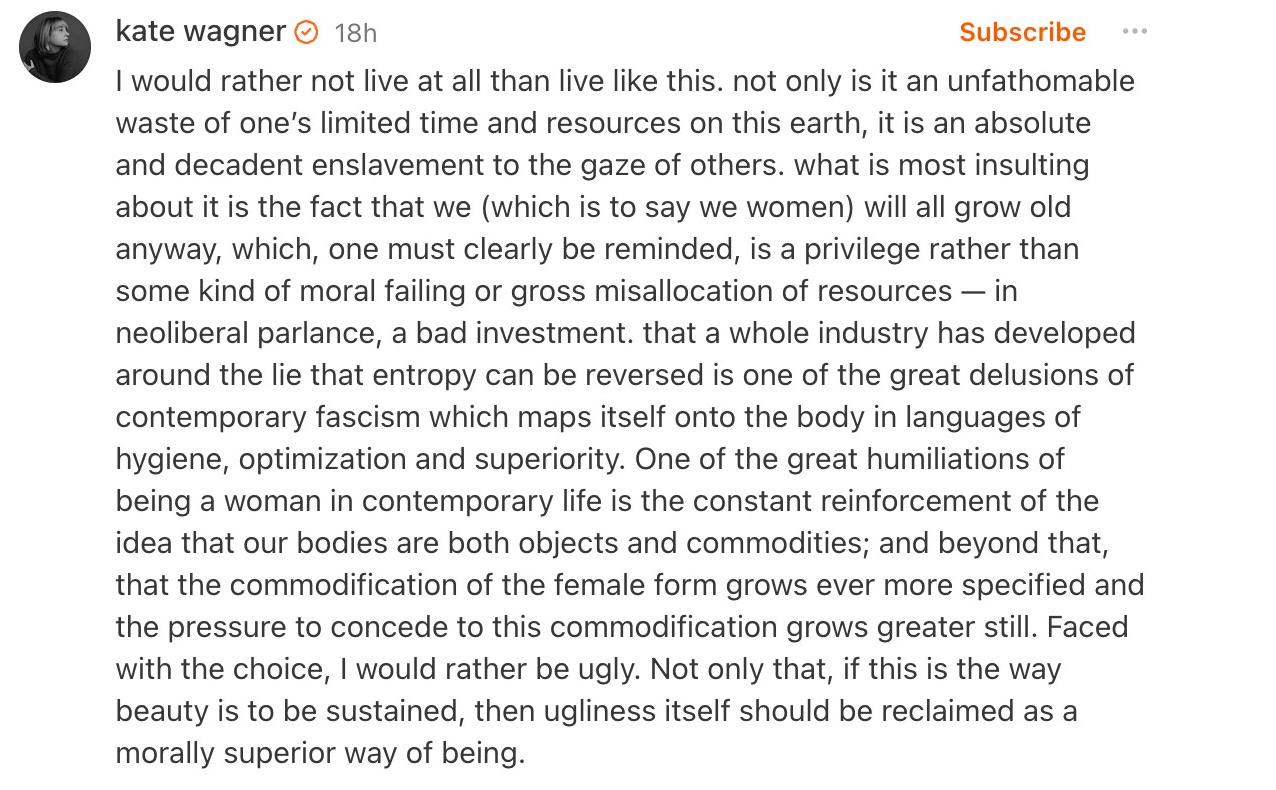
I would rather not live at all than live like this.
I’m going to assume this is rhetorical exaggeration because the alternatives to doing so are bleak.
not only is it an unfathomable waste of one’s limited time and resources on this earth, it is an absolute and decadent enslavement to the gaze of others.
I will admit that the maxxing routine described in the Laura Reilly post that Kate was responding to here is rather cartoonishly extreme! It at least seems like a lot. But I also recognize that I don’t know what her time and resources are like, and my impression may be inaccurate. Getting Botox only takes half an hour every few months. Skincare is no big deal when it’s routine, no matter how many steps. Who am I to say this woman I don’t know is wasting her limited time and resources? (And a lot of this is just like, normal medical stuff she happened to do all in the same month?)
Let’s first turn to something that will come up several times: a moralistic presumption that scarce resources are being squandered on health and beauty, as if all resources should be going to an urgent, pious activity or cause instead. This is not so different from self-hating gay Stephen Adubato’s “you shouldn’t have time to work out” shtick, demonstrating, to wit, the lockstep agreement of slop feminism and slop Catholic reaction in the opinion, If you’re living as God intended, i.e. not as a vapid neoliberal bimbo or a decadent faggot, you should not have time to be hot.
This sentence also introduces a blinkered understanding of what it means to care or not care what other people think. It suggests that being concerned with how one appears socially, and thus one’s aesthetic being in the world, is “enslavement” rather than a core feature of human sociality and a marker of civilization. It harbors an implicit antisocial individualism, as if one is “supposed to” be—as if it is somehow morally superior to be—indifferent to other people’s thoughts and tastes rather than performing for and provoking them. (We were put on this earth to serve in the gay sense as well as the Christian one.)
what is most insulting about it is the fact that we (which is to say we women) will all grow old anyway, which, one must clearly be reminded, is a privilege rather than some kind of moral failing or gross misallocation of resources — in neoliberal parlance, a bad investment.
The fact that we will all grow old and die someday has precisely nothing to do with the choices we make about how we look while we’re alive. OK, in the most general sense, it’s always good to remember you’re going to die. But again, appreciation of life does not have to be a scarce resource or a pole in a zero-sum game. One can be grateful to live a long life, fully aware that most things have little existential weight, and still zestily pursue pleasure, health, and ongoing aesthetic improvement.3
that a whole industry has developed around the lie that entropy can be reversed is one of the great delusions of contemporary fascism which maps itself onto the body in languages of hygiene, optimization and superiority.
No one would deny that there are resonances between Trumpism and the “languages of hygiene, optimization and superiority” teeming on social media, or that some purveyors of those languages have explicitly aligned themselves with MAGA.4 But maps itself onto the body is the kind of language academics use to remain deliberately vague about the causality or the precise nature of the relation. Discourses of strength, health, hygiene, status, etc, are present in all modern ideologies, not just “fascism.” It is probably more accurate to say that these concerns are irreducible features of human nature and society; they re-emerge in different forms in moments of uncertainty and crisis.
The “industry” here is not specified—GLP manufacturers? Med spas? Content creation?—but whatever it is, we can be assured that it does not make this sentence make any more sense. To equate all of these things—Trumpism, scientific research that has discovered something that is transformative to human health and medicine, and looksmaxxing discourse—as somehow rooted in a common “lie that entropy can be reversed” is to generalize so recklessly as to make the entire thing nonsensical. So Trumpism has a stupid narrative about reversing American decline, and some hacking/maxxing people take it to an off-putting extreme. Does that make any of these “entropy-reversing” impulses—to manage American decline, to use the latest technology to improve one’s health or slow aging, or to get excited about improving your appearance if you’re ugly and lonely—inherently suspect? Inherently fascist?
One of the great humiliations of being a woman in contemporary life is the constant reinforcement of the idea that our bodies are both objects and commodities…
Sigh. I cannot express how dismaying it is that no one can come up with a better language for talking about bodies and social-sexual relations than this.
Objectification generally refers to surface assessments of someone’s value, generally their sexual attractiveness, at the supposed expense of their personhood. It is said to be “good” to treat someone as a whole human/person and “bad” to do the opposite, i.e., to treat them as an object/body. Objectification is a particularly bad thing that men do to women and, if they’re gay, to each other.
I understand how this notion could have arisen from situations where women were fighting for respect and inclusion, where they are trying to be taken seriously in a profession and continue to be treated as exoskeletons of hot body parts that lack personhood. But this is generally not what is meant by objectification today, where it is divorced from any concrete political meaning and used as a generalized swear word for any sort of assessment of physical appearance whatsoever. Which puts everyone in the bad-faith situation where assessing other people’s appearance or sexual attractiveness is officially “bad” or verboten and yet we all do it relentlessly in our heads, in our group chats, or wherever. There has to be a better way.
My off-the-cuff proposal would be to reject the imagined binary between person and object altogether. We are quite literally objects, embodied physical things in the world. An enormous amount of our sociality, virtually every aspect of our interactions with other people, implicates our objectness, our flesh. “Person” and “object” are not opposites, we are always both at once, and both of those can be lenses through which we view other people at different times, from different angles of concern. Or even at the same time.
And why must “object” signify inferior, misrecognized, abused, as opposed to things like fashioned, created, given? When I look at my body in the mirror, I see an object, yes, but an object that incarnates my personhood. A thing, but a thing I have made, a physical monument to a much more expansive work of self-fashioning. A thing that I continually remake for the sheer pleasure of doing so and, secondarily, for the enjoyment of anyone else who wants to do so. There’s a line in the gay writer Mark Merlis’ novel An Arrow’s Flight that expresses this:
He remembered when he would look at his body and see: a gift to men. Not with narcissistic self-regard, with joy that he had it to give, that it was built, every contour and concavity, for pleasure.5
Don’t we all secretly want to be treated as objects, to feel the joy of having something to give in that particular sense—far from the only one, far from the most important one, but an important one?
and beyond that, that the commodification of the female form grows ever more specified and the pressure to concede to this commodification grows greater still.
I realize that the stance I just articulated may feel alien to some people for any number of reasons, including simply not caring that much about, or wanting to put that much effort into, how they look. The good news is that the actual number of people who are getting plastic surgery and biohacking—even the number of people getting a non-invasive, inexpensive yet miraculous treatment like Botox—is still pretty small. It’s a vanishing minority! The great, vast majority of people put a normal, that is to say quite minimal, effort into their appearance. Informality and the utilitarian bare minimum reign comfortably supreme as the stylistic ethos of mass-democratic culture.
Which means that this commodification of the female form growing ever more specified, if it even exists, is just…discourse. It’s just what a few people are doing, a few people are talking about, a few people are hawking and influencing and marketing. Most people don’t participate in it, and certainly not to an extreme degree, and you don’t have to, either. We might note that a few sentences back, caring about what other people think looks good was a baleful indicator of “enslavement”; now it’s somehow unfair to have to go against the “pressure” of the supposed herd.
Faced with the choice, I would rather be ugly. Not only that, if this is the way beauty is to be sustained, then ugliness itself should be reclaimed as a morally superior way of being.
The petulance of this final bit is revealing, but the first-person framing also is what makes it a respectable sentiment: If this is what it takes, *I* would rather be ugly. That’s a statement of personal value and choice. But people do not want their own rejection of what it currently takes, or their discourse-based fantasy of what it currently takes, to be only a personal choice; they want to politicize it so that the people who make a different one can be comfortingly labeled avatars of commodification or sexism or neoliberalism or even fascism.
It’s one of the greatest achievements of advanced industrial civilization that it makes socially unnecessary luxuries available on a mass scale for our personal pleasure, self-creation, and social presentation; that it gives us the means to simultaneously remake ourselves and beautify society. I think the reasons we should not want those things to become associated with fascism are self-evident, but that’s just me.
I don’t really want to use this idiotic term, but to its credit it is more economical than “physical appearance optimization” or even “trying to be hot.”
Who is highly relevant to this conversation and probably the main reason it is even happening.
I would argue that it is all the more heroic to do so when one is actually in decline, in other words, the opposite of the strange notion that surrendering to the ravages of age is somehow inherently a sign of dignity or grace.
It is important to register, perhaps too important for a mere footnote, that a significant part of social media fitness and beauty content is completely wholesome and democratic in spirit.
These are the thoughts of a character whose body has wasted away from AIDS; he is reflecting nostalgically on how he felt in the past. One riposte might be that this is all just the privilege of the healthy and able-bodied talking, and that it would sound ridiculous if I were to face serious physical trauma. To which I would say that makes feeling joyously embodied all the more poignant and a point of deeper gratitude, knowing that it could be lost at any time and will be eventually.
Well, that's a lot of five dollar words to try to prove a point. I can see your audience is struggling a bit. That's generally a good indication that you're being too wordy in an attempt to appear more knowledgeable, but the quality of your writing is suffering as a result. Just a helpful observation.
TL;DR: Man wades into female conversation and is immediately in way over his head. Proceeds to sputter and spit, as his head bobs along, breaking the surface, but never his superior tone. Eventually, we catch his final words, amidst all the gargling and gasping, just before he slips below the silent, black water for good: "Well, actually ...." 😉
Hey so this sucks, disregards the meaning of the original note, which was about *women*, and only reinforces sexist tropes.