


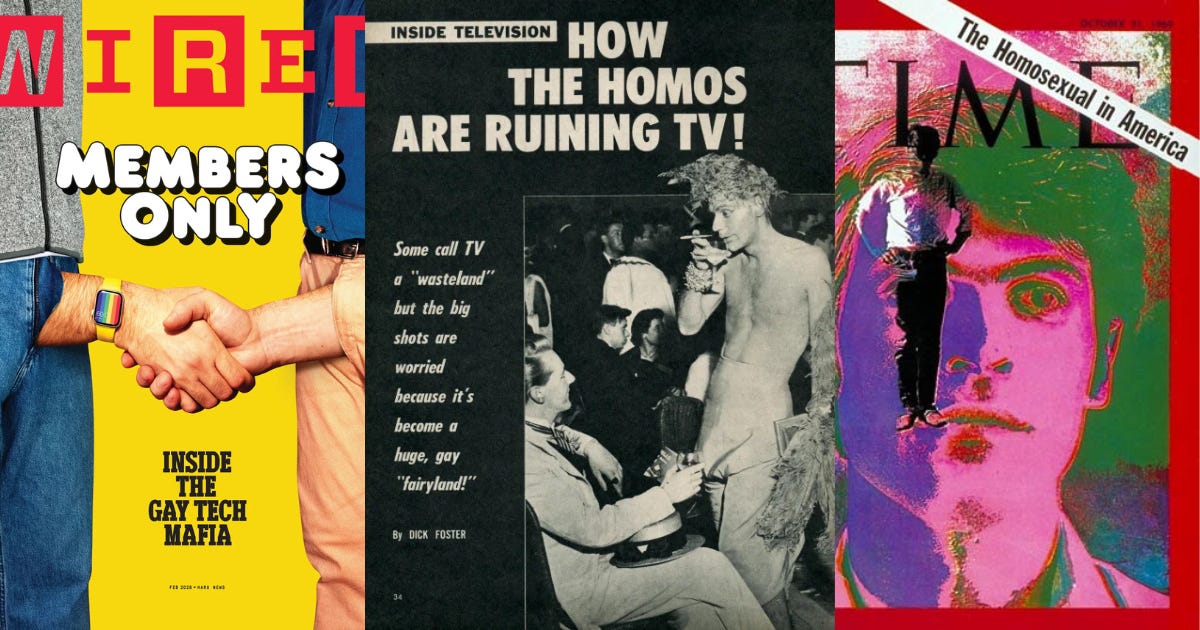
Wired’s latest cover story, “Inside the Gay Tech Mafia,” makes last year’s celebrated but journalistically undercooked Harper’s story about gooning look like an FBI investigation. (Maybe the kind of ginned-up FBI investigation that once got thousands of gay men fired from their jobs, but one that at least went through the motions.) In this case, the story can be summed up with only the slightest exaggeration: Rumors, anonymous tweets, and off-the-record phone calls suggest gay men run Silicon Valley.
What’s especially funny is that the story is haunted almost from beginning to end by the possibility that it is perpetuating a non-story, or perhaps even a homophobic conspiracy:
On its face, a gay tech mafia seemed too dumb to warrant actual investigative inquiry. Sure, there were gay men in high places: Peter Thiel, Tim Cook, Sam Altman, Keith Rabois, the list went on. But the idea that they were operating some kind of shadowy cabal seemed born entirely of homophobia, the indulgence of which might play into the hands of conspiracy-minded conservatives like Laura Loomer, who, in 2024, tweeted that the “high tech VC world just seems to be one big, exploitative gay mafia.”
The problem is that people just won’t stop talking about it.
Journalism is a cyclical business, and Wired has resurrected a twenty-first century version of the Homintern conspiracy. “The Homintern theory,” Gore Vidal wrote in 1970, “is a constant obsession of certain journalists and crops up from time-to-time not only in the popular press but in the pages of otherwise respectable literary journals.” Homintern was a play on the Comintern or Communist International, founded by Lenin in 1919 and widely seen as a front for Soviet subversion in interwar Europe. Possibly coined by W.H. Auden, it was initially an inside joke about a group of European gay writers who knew each other in the 1920s and 1930s, but one that turned deadly serious, particularly in the Cold War United States.
The Homintern conspiracy played on gay male artists’ self-aggrandizement as a cultural elite and served as a screen onto which to project anxieties about subversion, both of national security and of moral order. It came down to the idea, the main component of the conspiracy still present in the Wired story, that gay men are so tightly networked with each other that they subvert normal divides between nation, class, age, etc, and are therefore more likely of being political subversives. As the historian Gregory Woods writes:
The salient feature of the widespread, paranoid association of homosexuality with espionage is the suspicion that homosexuals may form stronger allegiances to others of their own kind, across national boundaries, as well as across other social subdivisions such as classes, than to their own fellow nationals. In this respect, the cosmopolitanism of homosexual people was thought similar to, and congruent with, that of the Jews.
At the same time the U.S. government was systematically investigating alleged homosexual subversion in the government, the Homintern provided an update to the classic artists’ conspiracy that blames elite cliques for “gatekeeping” and blocking honest outsiders from success. In both the U.S. and Europe, journalists and other cultural commentators complained about the gay mafias secretly running cultural fields and perpetuating subtle contempt for straight society. These connected gay men all knew and (presumably) slept with one another, despised women, kept honest straight men from success, and, as Time put it in 1969, were waging a “vengeful counterattack” on “things that normal men take seriously.”
Some of these articles are worth quoting for the flavor—how silly and amusing they sound in retrospect.
New York Times theater critic Howard Taubman, 1961:
‘Tis time to speak openly and candidly of the increasing incidence and influence of homosexuality on New York’s stage—and, indeed, in the other arts as well. The subject is too important to be left forever to the sly whisperers and malicious gossips. Criticism, like playwriting, is crippled by a resort to evasions. The public is deluded and misled if polite pretenses are accepted at face value. The infiltration of homosexual attitudes occurs in the theatre at many levels.
Robert Doty, in the front-page 1963 Times story that bore the now-infamous headline “Growth of Overt Homosexuality in City Provokes Widespread Concern”:
Their presence in creative activity is not, as an old myth fostered by homosexuals would have it, because inverts tend to have superior intellect and talent. Most students of the subject agree that the significant factor in homosexual colonization of some of the arts is that men who would find difficulty in winning acceptance from fellow workers in more prosaic activities naturally gravitate toward solitary, introspective endeavor. The list of homosexuals in the theater is long, distinguished and international. It is also self-perpetuating. There is a cliquishness about gay individuals that often leads one who achieves influential position in the theater-as many of them do-to choose for employment another homosexual candidate over a straight applicant.
Erick Foster, “How the Homos Are Ruining TV” (1964), dispensed with the Times’ respectable reserve:
Nobody knows for sure how many pansies there are in TV. But things have gotten so out of hand in this new Sodom...that you can’t tell the he-men from the she-men without a scorecard. Right now the twisted twerps not only are in a position to tell you what you can see as entertainment, they are recruiting others of the lavender set to give it to you!
Time, “The Homosexual in America” (1969):
On Broadway, it would be difficult to find a production without homosexuals playing important parts, either onstage or off. And in Hollywood, says Broadway Producer David Merrick, “you have to scrape them off the ceiling.” The notion that the arts are dominated by a kind of homosexual mafia—or “Homintern,” as it has been called—is sometimes exaggerated, particularly by spiteful failures looking for scapegoats. But in the theater, dance and music world, deviates are so widespread that they sometimes seem to be running a kind of closed shop. Art Critic Harold Rosenberg reports a “banding together of homosexual painters and their nonpainting auxiliaries.”
The gay mafia of the mid-century cultural sphere was said to be infiltrating, cliquish, self-perpetuating, recruiting, running a closed shop—exactly what the gay mafia is now alleged to be doing in Silicon Valley.
Obviously it’s 2026, so the gay mafia allegations don’t have quite the homophobic edge they did even in the 1990s, when magazines were obsessed with a “Velvet Mafia” in entertainment. The Wired story is, as mentioned, aware that it runs the risk of perpetuating a conspiracy theory suggested by right-wing figures; it even packages itself in an overarching skepticism. But it’s remarkable—almost comical—how it continues to insist on the gay mafia despite repeatedly coming up with either banal facts or vague rumor. The number of times we are told that, despite the lack of evidence, people can’t stop talking about it!
And yet, similar rumors persisted and compounded, originating as often from outsiders (sometimes with dubious political motivations) as from insiders. When I call up my longtime industry sources to get their thoughts on the gay tech mafia, not only have they heard of it—they have highly specific notions of how it works. These are credible people who believe seemingly incredible things. One San Francisco investor tells me that he believes the Thiel Fellowship is a training ground for gay industry leaders. (When I run this notion past a couple of former Thiel Fellows, they tell me they met Thiel one time at a dinner, where he appeared “slightly bored,” says one of the fellows, a straight man. “I mean, I wish Peter tried to groom me.”) Meanwhile, people’s gaydars are practically overheating. I hear, more than once, that anyone in Silicon Valley who has achieved outsize success is probably gay.
We have the classic straight guy claiming discrimination at the hands of the Homintern:
Last spring, at a venture capitalist’s party in Southern California, a middle-aged investor complained to me at length about how he was struggling to raise his new fund. The problem, he explained, boiled down to discrimination. … He looked exactly like the sort of man Silicon Valley has been built to reward. And yet here he was, insisting that the system was rigged against him. “If I were gay, I wouldn’t be having any trouble,” he said. “That’s the whole thing with Silicon Valley these days. The only way to catch a break,” he claimed, “is if you’re gay.”
Among the other scandalous facts we learn:
Wealthy men in the same industry who have things in common know and sometimes do deals with each other.
Wealthy men in the same industry who have things in common are sometimes in group chats with each other.
Gay men have Halloween parties for gay men where no women are invited.
Barry’s Bootcamp in the Castro, a gym in one of the gayest neighborhoods in America, is full of gay men with abs.
The lines between friendship, professional network, romance, and sex tend to be blurrier for gay men than for straight people.
Gay men gossip about and accuse each other of sleeping with each other for favors, whether they actually do or not.
I cannot stress enough the degree to which the story constantly debunks itself:
None of this is necessarily unfamiliar in the clubby world of Silicon Valley, where the smart, successful, and wildly rich have always formed in-groups. There’s the so-called OpenAI mafia and the Airbnb mafia, and before those the PayPal mafia—alumni of moonshot companies who bankroll the next wave of startups. So some of what reads as advantage is, on closer inspection, structural and unremarkable. San Francisco combines two things in unusual density: one of the country’s largest gay populations and a tech industry that has reshaped global power.
What makes this a truly twenty-first century Homintern story is the degree to which gay men are happy to play up the idea that they are a special, influential elite—even though, as the reporter wistfully tells us, they kept their juiciest gossip off the record.
The only real air of scandal here comes from the fact that Silicon Valley power, and its growing association with the MAGA right, is increasingly in the cultural crosshairs. We get the weakest gesture that there’s an untold MeToo story the reporter couldn’t deliver. It turns out the Homintern myth can also serve skepticism of Silicon Valley elites and the AI cult, giving us visions of a cabal that plays by its own rules and has contempt for normal society. But none of that really needs revealing; we already know this about Silicon Valley, and it’s unfortunately far too endemic to be a gay thing.
Like I said, I don’t think the story is deliberately homophobic or anything to be terribly exercised about. But, you know, people just won’t stop talking about it.
It was really quite something to read those comments from mid-century theater critics!
"I mean, I wish Peter tried to groom me" is actually hilarious :)
I had managed to forget about that stupid gooning article…. you just had to mention it didn’t you? 😑