


You may have noticed that I’m making a podcast since I’ve been cross-posting it here, presumably to the annoyance of the people who unsubscribe every time I do. That’s partly what this post is for: to warn you that I will eventually stop doing that, and to encourage you to subscribe to the Christopher Street Substack so you keep getting new episodes and bonus content that Blake Smith and I will be posting there.
But I also thought I’d take the opportunity to tell you a bit more properly what it’s about.
Christopher Street was originally published from 1976 to 1995. It’s often referred to as the “gay New Yorker” and nourished the careers of giants like Edmund White and Andrew Holleran, as well as criminally forgotten figures like George Stambolian. One of its editors, Michael Denneny, is well remembered as a gay publisher but not well enough as a student of Hannah Arendt and political theorist of gay male identity. I got interested in the magazine partly through On Christopher Street, an anthology of Denneny’s writing published in 2023, just before his death. I had been looking for a way to think about the gay world I was a part of, which seemed to exist in practice but not in thought, strangely orthogonal to the discourses on social media and the surviving husks of queer media. Reading Denneny from the 70s and 80s often felt like someone describing the gay world of today, which one now finds truly represented only in memes, tweets, and the occasional trend story in a straight magazine.
Last year I started digitizing the archives of the magazine. Partly because I was itching to design a website again, something I hadn’t done in almost 20 years. But mostly because Christopher Street, despite the prominence of its contributors, is very difficult to find. Unlike when you’re doing research on French history, when you’re interested in gay history, you often find that the foundational humanities work that is crucial to historical preservation and transmission, arguably the main thing the humanities should be for, lies untouched. When I was a “regular” historian, anytime I thought, It’s impossible no one has written about X, I was usually right: the article or the monograph was out there, I just hadn’t found it yet. With gay stuff, the opposite is true: if you think, Surely someone has written that, chances are they haven’t. Somehow, despite the humanities supposedly being nothing but woke gender ideology.
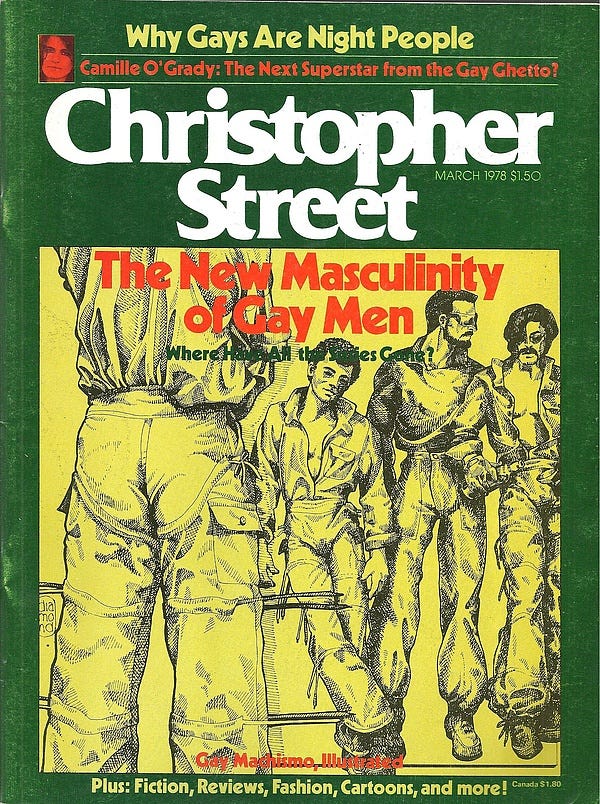
Christopher Street is historically important, sure. But more important than the stuff of the original magazine is what it was trying to do: to create a space for gay men to be fully who they are, to enter their own kind of public sphere, and to talk to, write for, and argue with each other. This is what we hope to do on Off Christopher Street: in each episode, we start from an article from the magazine that opens onto themes that still resonate in our lives today, from the fun stuff like being hot and going out to gender presentation and what gay identity politics might still mean in the twenty-first century. I hope it’s a version of the conversations I have with friends over drinks; it is quite literally an edited, longer-form version of mine and Blake’s voice notes to each other.
I’ve always thought the best projects feel like a somewhat inchoate but urgent impulse that pushes you to jump into them without fully knowing what you’re doing. (I’m certainly glad I didn’t know I was going to barely sleep for a few weeks as I learned the basics of audio production.) It’s exciting to try a new medium with different rules than writing, and to explore building an audience for thinking in this Wild West era of fragmentation and slop, which is nonetheless also a golden age of making things and finding one’s people.
Off Christopher Street is extremely gay, so I understand if you’re not the target audience, though I also hope that our thinking about life, culture, and politics at least somewhat transcends the narrowness of its immediate sociological focus. If it interests you in any way, I hope you will subscribe so we can reach you. (You can also subscribe on Spotify and Apple if you listen to podcasts there, or add the RSS feed to any other app. If you are feeling especially generous, giving us a rating or a review on those apps is also a huge help.)
Our first three episodes are below, and more on the way: pretty soon we’ll be hosting our first guests and talking about the gay Republicans in the Reagan-era New Right and the controversy over William Friedkin’s 1980 film Cruising.

Sounds exciting! Will definitely check it out :)