


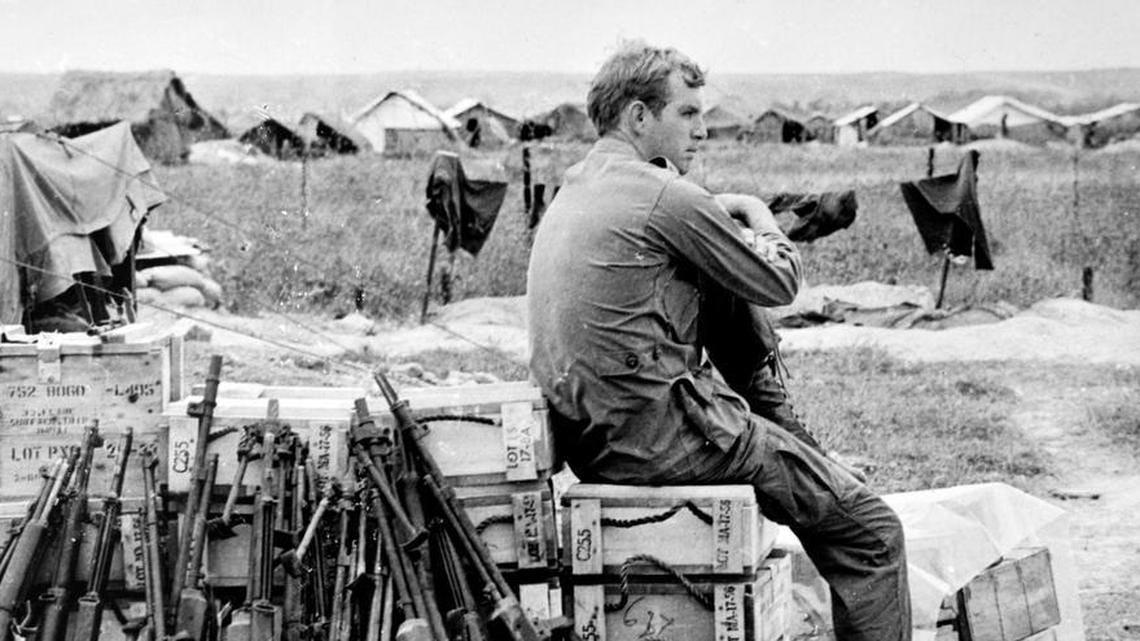
If I had been born a half-century earlier I suppose I could have been Perry Deane Young: born on a farm in North Carolina in 1941, one of 13 children, ashamed of his southern accent when he left home to eventually become a journalist in the liberal media, where he, too, covered evangelicals and, decidedly unlike anything I ever did, completed Army basic training and arrived in Saigon the night before the Tet Offensive to cover it for United Press International. I can certainly relate to this: “I was caught between the mind-crippling force of fundamentalism and the promise of freedom and life through learning on the other. If that conflict has often been painfully frustrating and confusing, it has never been dull.”

Young relates some of his personal connections to the world of reactionary evangelicalism in his 1982 book God’s Bullies, an excerpt of which Blake and I talk about with Daniel Lefferts on the latest episode of Off Christopher Street. This is presumably why it originally bore the odd subtitle, Native Reflections on Preachers and Politics (later changed to the more fitting Power, Politics and Religious Tyranny).1 That notion of “native reflections” can’t help but pique my interest; apparently hayseed southern gay boys were using their religious background as a brand even before I was born.
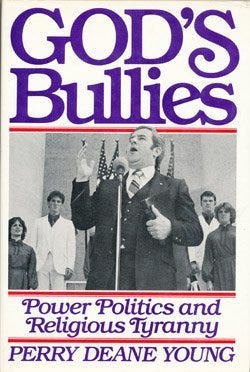
God’s Bullies is an odd book: part memoir, part investigative report, part potted religious history, part discursive polemic. Young frames it as a reckoning with his own family history—his biological grandfather was sentenced to a chain gang for fornicating with a pastor’s daughter, and his adoptive one was an abusive Biblical literalist—and as a sort of broad argument against religious intolerance. There is a critique of bad Christianity in the name of good Christianity, namely, his mother’s racial tolerance and acceptance of his homosexuality and his siblings’ liberal Protestantism. Young suggests that by rejecting Christianity and looking back at his origins from the outside, he was able to appreciate it more rightly than those who claim to speak for it—that classic posture of “I, the apostate, am a more authentic Christian than you are”:
By facing up to and overcoming the very real hatred I felt for my preacher ‘granddaddy’ and his kind, I was finally able to understand and love those people, my people. It was necessary to hate the man in order to love him, necessary to become a non-Christian in order to understand and appreciate the enduring truth and beauty of the teachings of Christ himself.
The polemical thrust of the book is that the New Right is a dangerous, theocratic assault on American ideals, but also one that is riddled with contradictions and which does not have anything like broad public support. One picks up traces, as Blake suggested on the podcast, that no one is quite sure how seriously to take these people yet. Who is screwing whom in the New Right hodgepodge? The barely closeted Terry Dolan appears to be a social libertarian despite collaborating with Falwell, and many Republicans see Reagan as caring about taxes and foreign policy, not abortion and homosexuality. What Young seems to be suggesting in this scattershot, unfocused book, is that it doesn’t matter; despite the disclaimers and qualifications, everyone in the New Right is collaborating with the religious nutjobs, they know they are doing it, and it’s bad.
We spent most of our time on the podcast talking about Young’s confrontation with Dolan about his homosexuality, which he builds up as a dramatic scene (“I was nervous, sweating, in my discomfort over what to say and how to say it.”) Young couldn’t resist psychologizing some of his subjects, but it’s noteworthy that most of his scene with Dolan is about the latter’s political doublespeak. Dolan had, to the annoyance of Paul Weyrich, an actual social conservative, given repeated, all-over-the-place interviews to gay journalists, including one with Larry Bush in The Advocate in which he said he favored federal discrimination protections for homosexuals and that “sexual preference is irrelevant to political philosophy.” This was trumpeted in the mainstream press as a major development: the Washington Post noted that “this clearly sets Dolan apart from a host of his allies on the political right who have vigorously campaigned against gay rights,” at which point Dolan denied the quotes and re-emphasized his intimacy with Falwell.
We might say that Young gets carried away with the story of Dolan and includes the not-that-salacious details of his sex life because of some dark gay fascination with the self-hating homosexual. (Will Dolan kill himself if I confront him? Will he kill me?!) But the surely legitimate journalistic mission he sets out to accomplish is to pin down a powerful political figure who is constantly blathering out of both sides of his mouth and thereby to establish how seriously to take New Right fundamentalism, indeed how seriously its leaders take it. Young doesn’t quite deliver this—Dolan continues prevaricating—but he does establish that this person is a liar who is used to shaping reality however he pleases, and whatever he tells any gay journalist, he is at best a cynical collaborator in the anti-gay project. Though maybe that should have been obvious to begin with?
The reported chapters of God’s Bullies overflow with detailed facts about the origins, networks, and funding structures of conservative organizations, like the outline of an early draft of Reaganland. (Young even says all of this is Jimmy Carter’s fault!) But he does like his out-of-pocket (in the Gen Z sense) psychologizing, visited in much more amusing ways on targets like Anita Bryant, who he describes as so lonely and sexually repressed that she clamors for personal attention from any journalist who writes about her. The journalistic fascination with repressed, contradictory subjects apparently isn’t only for gays:
Ken Kelly, whose interview with Bryant in Playboy exposed her to further ridicule for her naive musings about sex2, came away with even stronger feelings for and about Bryant. He had despised her husband and what both of them were doing and saying, but at close range he could only feel pity for the woman herself. For weeks after Kelly did the interview, he would get phone calls from Bryant. There was no reason for them—she just wanted to talk to somebody.
It finally dawned on me and others that the woman was lonely. She was starved for affection and had serious sexual problems of her own. Hers was the shrill voice of sexual repression. She was a far worse victim of oppression than most of us homosexuals are. We all have suspicions of such motivations every time we hear somebody raging on about other people’s sex lives, but rarely has anyone defined and explained them as bluntly as Bryant has.
That is certainly a take. Howard Phillips, the former Nixon man and co-founder of the Moral Majority, is profiled in a chapter called “The Gauleiter Jew”:
In the company he keeps, Howard Phillips is often the only Jew on the speakers’ platform, and more often than not the only Jew in the whole auditorium. Any suggestion that there is anti-Semitism in the new right is invariably met with the statement, “Howard Phillips is a Jew.” … Thus it is understandable that while Howard Phillips’ religious background is not a difference he tries to hide, neither is it one he chooses to emphasize. One is led to the inescapable conclusion that along with his hatred of homosexuals and denigration of women, he also shares this other hatred of Jews, his own kind, himself. Phillips was the only new-right leader I interviewed who was evasive and reluctant to talk about his childhood.
Young’s speculation about how Dolan and Phillips manage having identities to which the New Right is hostile is probably best understood as attempts to support his overall thesis, which is something like that all of these people are hypocrites. Dolan the anti-gay homosexual, Phillips the anti-Semitic Jew, Falwell the opportunist, Weyrich the “congenial” theocrat who reporters all love because he’s nice but then talks in private about how he wants as few people as possible to vote. And poor Anita Bryant, who is, in her words, “just a woman.”3 Charges of hypocrisy have long been one of liberals’ favorite ways to deal with the religious right, but it doesn’t work today and arguably never has. So much of the great foulness of our time goes back to the fact that these people have always cared about nothing but crushing their enemies.
Though his book about David Kopay, the first (ex-)NFL player to come out as gay, is subtitled An Extraordinary Self-Revelation. Maybe books just had bad subtitles back then?
BRYANT: Why do you think the homosexuals are called fruits? It’s because they eat the forbidden fruit of the tree of life. God referred to men as trees, and because the homosexuals eat the forbidden fruit, which is male sperm…. There is even a Jockey short called Forbidden Fruit. Very subtle. Did you know that?
PLAYBOY: No. We’ve heard only of Fruit of the Loom.
Phyllis Schlafly, a real woman, would have been a great fit for this pantheon of Christian right hypocrites.
you might appreciate this https://pieterlvalk.substack.com/p/from-drag-to-dimes-square-the-return