


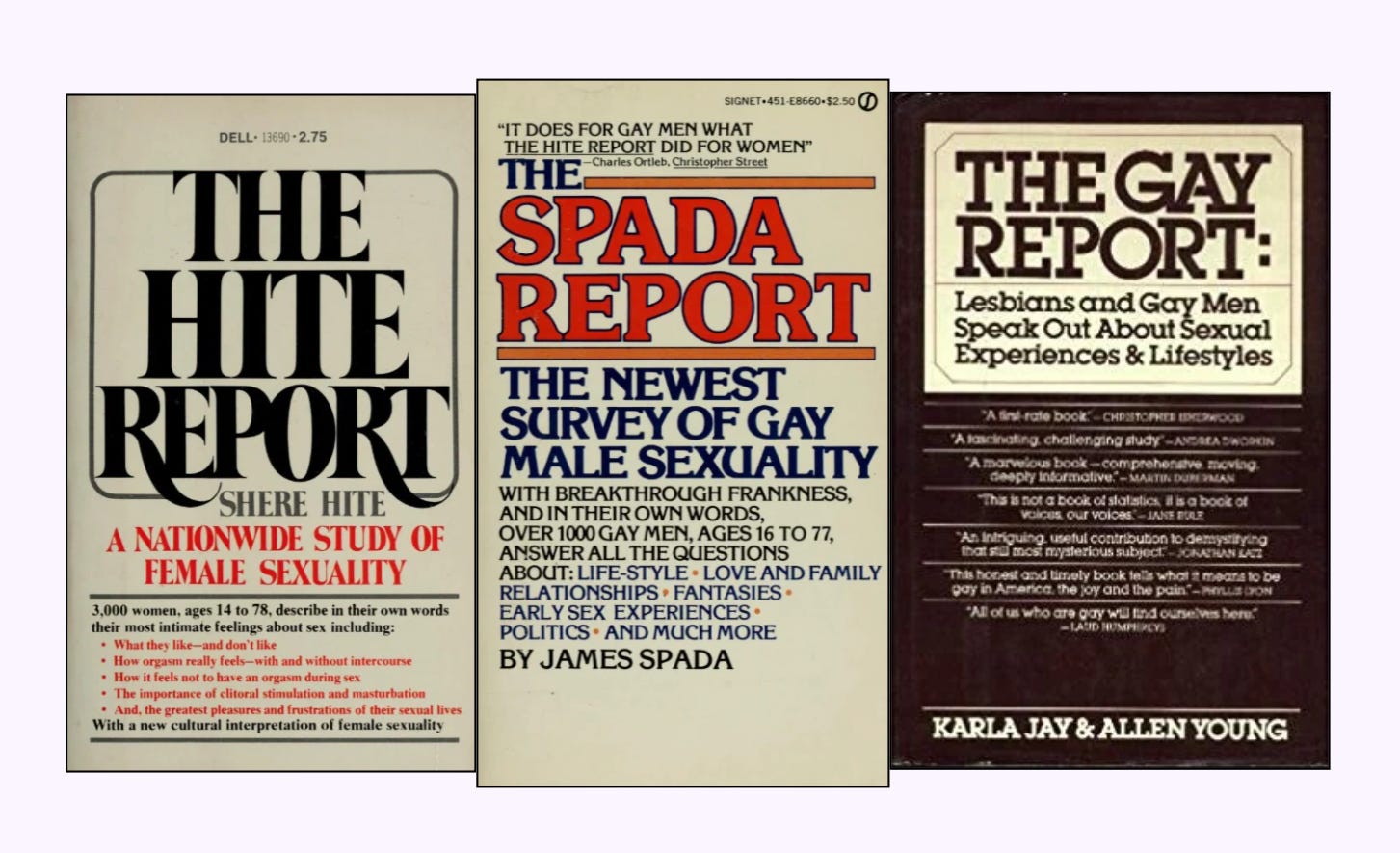
James Spada (1950-2017) was a journalist who wrote about film and photography and, finding a clever way to monetize his childhood obsession with collecting photos of female celebrities, published numerous coffee-table books on gay icons like Barbra Streisand, Bette Davis, Judy Garland, and Liza Minnelli. Born on Staten Island, he interned for Senator Ted Kennedy and saw himself, if not a gay activist exactly, as someone called upon by history to do his part. In June 1977, as Anita Bryant’s “Save Our Children” campaign was making national headlines and galvanizing gay political activism around the country, Spada attended a rally in Hollywood and then wrote a letter to his father that was also published in the Los Angeles Times:
Today, as I’m maturing, I’ve made a conscious decision to lead a gay lifestyle. This doesn’t mean I dress as a woman; it doesn’t mean I do nothing but have sex; it doesn’t mean I molest children; it doesn’t mean I’m any less of a man than I’ve always been.
What it means is that my circle of friends—I wouldn’t trade them for any other—is composed mainly of other gay men and some gay women who are just like everyone else, except that they love members of their own sex. Like me, these friends are active, productive and relatively successful. They’re warm, loving, sensitive, fun to be with. The men I date work as lawyers, house painters, artists, singers, political aides—the gamut. Some of my relationships with men are sexual, others might consist of going to a movie and having a hamburger afterward. The point is, my friends and the men I date bear no resemblance to the men and women Anita Bryant would have you believe represent all homosexuals.1
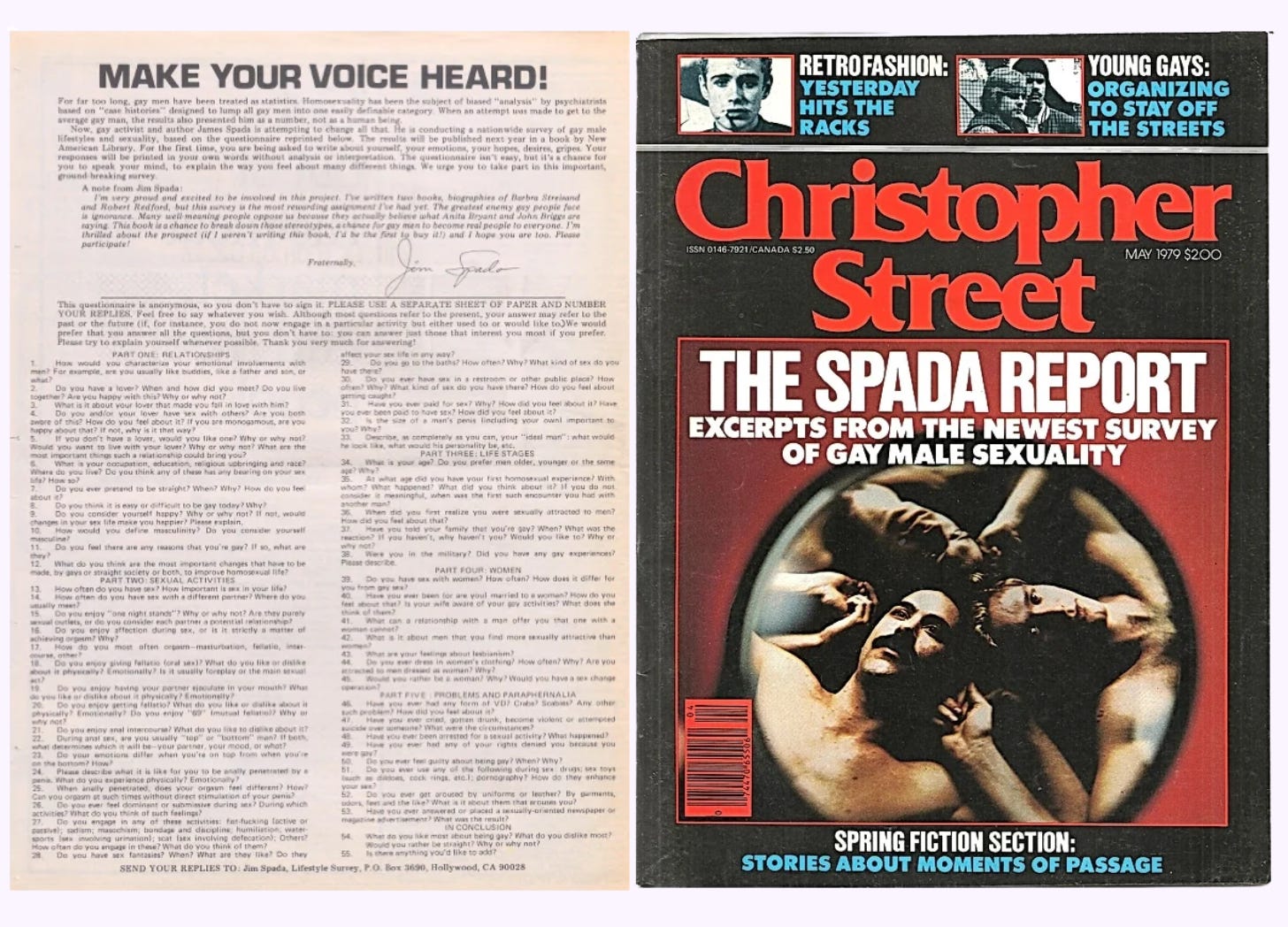
A few months later, Spada told The Advocate that he had a “perfectly pleasant” phone conversation with his father, who made no mention of receiving the letter. By then Spada had signed a contract with the New American Library, a publisher of mass-market paperbacks, for a survey of gay men about their romantic and sexual lives. “There won’t be any analysis or interpretation,” he said, “just a chance for gay men to speak for themselves about who and what they are.”2 The 55-question survey that would generate 1,038 responses for The Spada Report (1979) was distributed widely at gay bars and printed in publications like The Advocate and Christopher Street.
The 1970s saw a boom in mass-market sexology, a confluence of publishers’ pursuit of growing markets for books targeted at sexual identity groups and the activist impulses of young writers from those identity groups. In the same way publishers sought to follow up the blockbuster success of The Joy of Sex (1972) with gay-themed versions (Edmund White and Charles Silverstein’s The Joy of Gay Sex and Emily L. Sisley and Bertha Harris’s The Joy of Lesbian Sex, both published in 1977), they were eager to replicate the success of The Hite Report (1976), a survey of 3,000 women that delivered the earthshaking finding that 70% of women did not achieve orgasm from penetrative sex alone. Spada modeled his book on Hite’s qualitative questionnaire and absorbed her opposition to both the clinical sexology of Masters and Johnson and the quantitative work of the Kinsey Institute. (The latter, incidentally, would publish its million-dollar, government-funded volume on gay men in 1978, which handed the media—and Anita Bryant—the shock statistic that 43% of gay men had had 500 or more sexual partners.3)
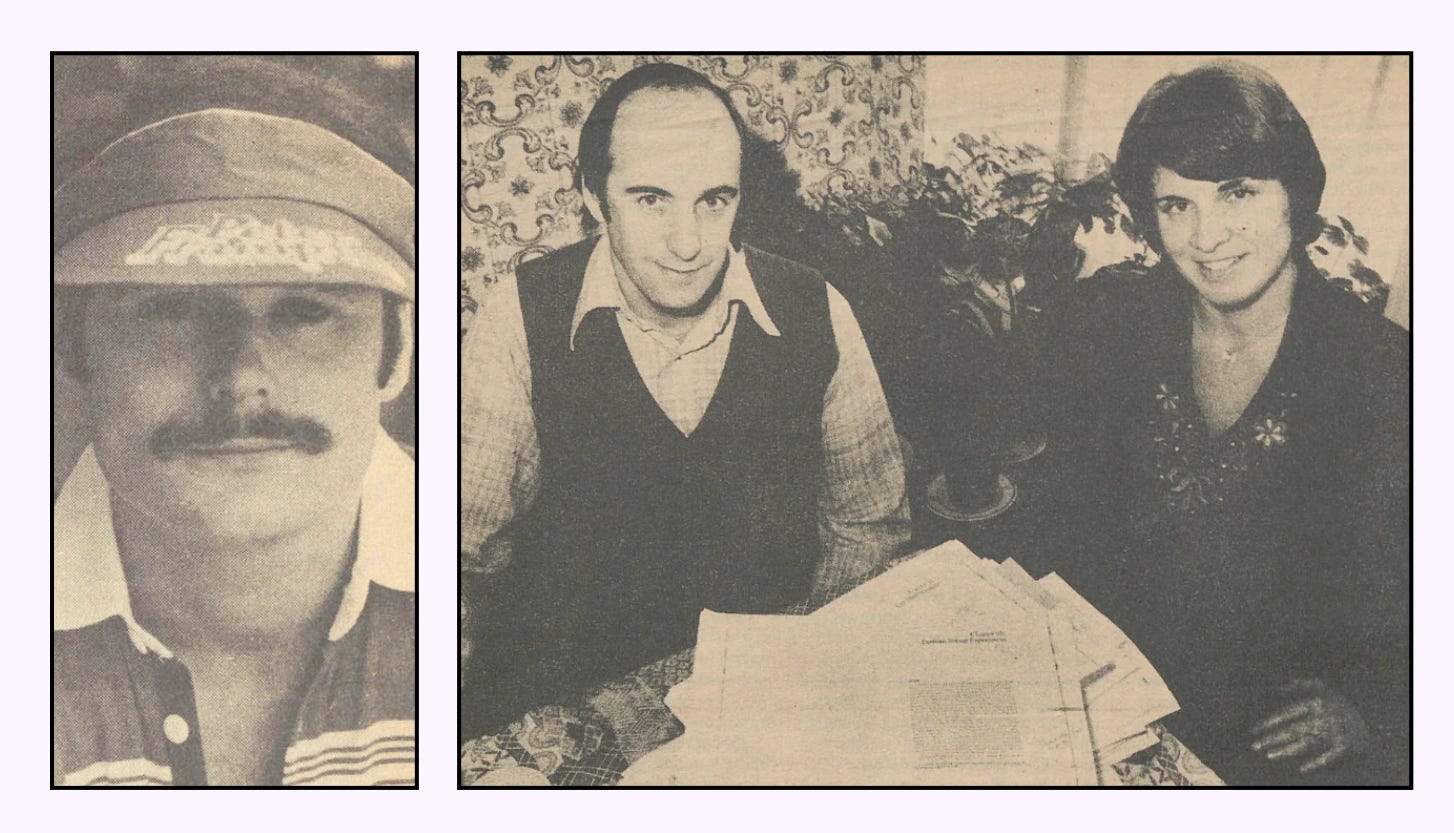
The Spada Report was not even the only work of gay “grassroots sexology” published in 1979. That term comes from Karla Jay, one of the co-authors, with fellow Gay Liberation Front activist Allen Young, of The Gay Report (1979), whose publisher also conceived it as a gay follow-up to The Hite Report. Jay and Young had already been publishing joint anthologies on gay literature and culture in the years after Stonewall, including the important early gay radical anthology Out of the Closets. They were more academically inclined than Spada: Jay was then completing her PhD in comparative literature at NYU and would go on to be a longtime professor of women’s studies; Young had master’s degrees from Stanford and Columbia and was a Fulbright scholar in Brazil. Theirs is in many ways the better of the two “gay reports,” with a more wide-ranging, indeed, almost tediously detailed questionnaire and larger respondent pool.4 The Gay Report also included both gay men and lesbians, though the authors guardedly acknowledged that there was little relationship between the sexualities of the two groups and that many readers would only be interested in half of the book.5
But the two books had a lot in common, most importantly a belief in the political value of gay people “speaking for themselves.” Both presented themselves in terms of two different goals: first as a collective representation of gay people to themselves, a form of “communication” between them, and second as a portrait for straight readers of the unclassifiable diversity of gay lives, sexual practices, and points of view. “We anticipated that the responses would show you cannot make any generalizations,” Young told The Advocate, perhaps momentarily forgetting his book’s abundant generalizations, like “the overwhelming majority of gay men are inveterate cocksuckers.” That there might be a tension between these two goals is suggested by Spada saying he looked for responses that “had a certain universality,” meaning responses in which gay men would recognize themselves, or suggesting that his study reflects the point of view of “average gay men.”6
Though all but forgotten (Spada doesn’t even have a Wikipedia entry), these books were each in their own way impressive feats of activist social research and still make rewarding reading today. As Don Shewey wrote of The Gay Report in the Boston Phoenix in 1979, “Depending on what chapter you flip to or what mood you’re in, the book can read like pornography, a sex manual, or a hilarious party conversation.” In this post, I compare and comment on some of the data on gay men from both studies; in a subsequent one I’ll pick out some of my favorite snippets and stories from their extremely rich, entertaining, and moving qualitative responses.
The data: different methods, complementary findings
What’s perhaps most surprising about the data in both studies is how unsurprising much of it is. Not only do their findings broadly agree with each other, on lots of questions they’re pretty much what I’d expect a similar survey to find today. These include large zones of gay life and sexual practice on which gay men seem to be overwhelmingly similar to each other:
Most men in both studies became aware of their homosexuality and had their first sexual experiences by early adolescence, while coming out is a more varied, gradual process
Most place a high value on affection during sex, even with casual sex partners
Long-term relationships and cohabitation matter deeply alongside casual sex
Oral sex is the most loved and most universally practiced sex act
A large majority enjoys anal sex, and a majority are versatile as opposed to strictly top or bottom
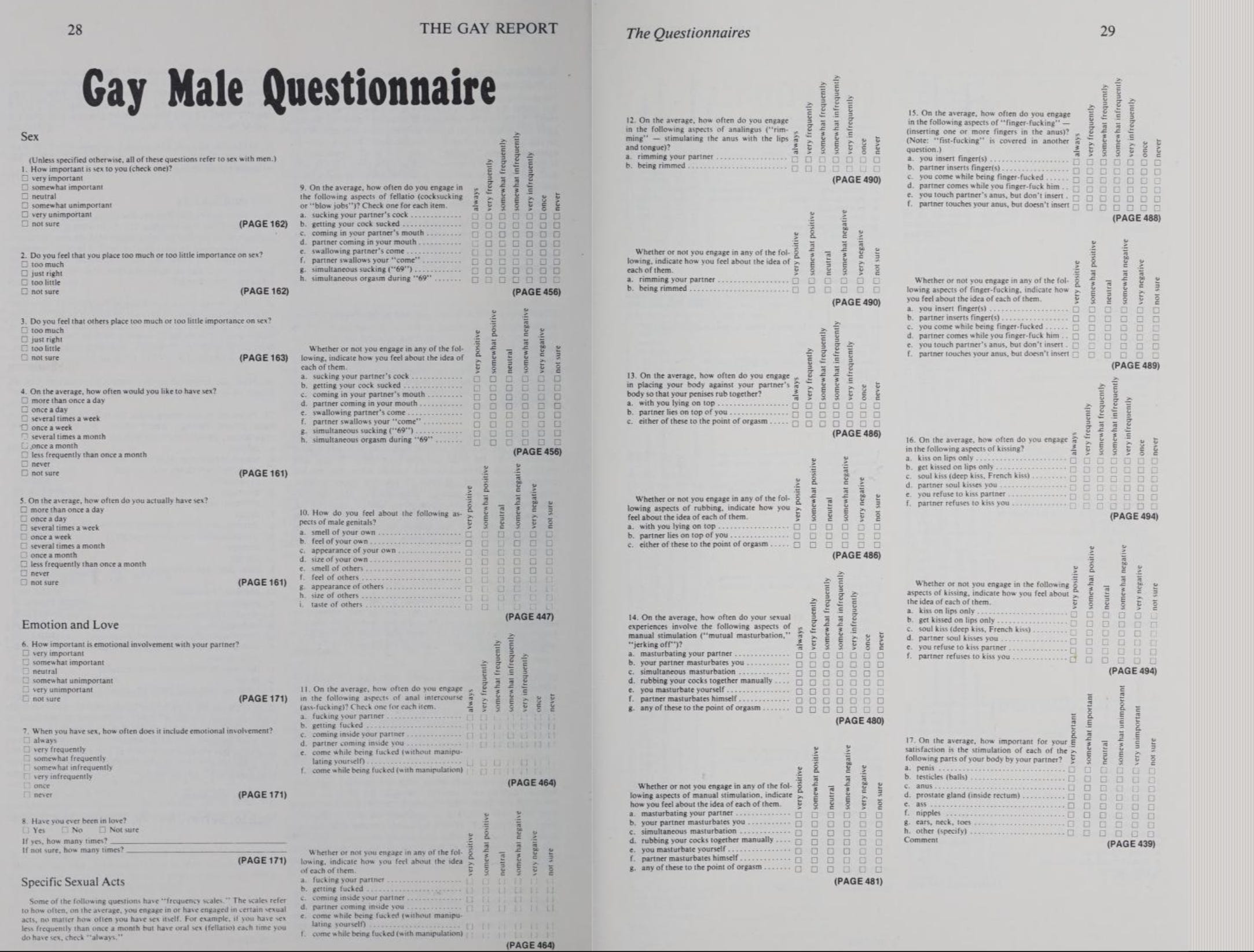
That said, The Spada Report and The Gay Report have different methodologies and sometimes asked about different things. Spada “post-coded” his responses, meaning he extracted data from open-ended answers. Jay and Young’s survey also had a section of open-ended “essay questions,” but the first half of their survey called for structured responses. These questions distinguish more systematically between behavior and attitudes, asking respondents to rank each on six or seven-point scales (from Always to Never, for frequency of behavior, or from Very Positive to Very Negative for attitudes). Jay and Young’s questionnaire is also much longer and more granular. So in some cases, even when the two are asking about a similar thing, the results are presented differently enough that they can’t be directly compared. And in some cases they asked different questions altogether.
The myth of tops and bottoms
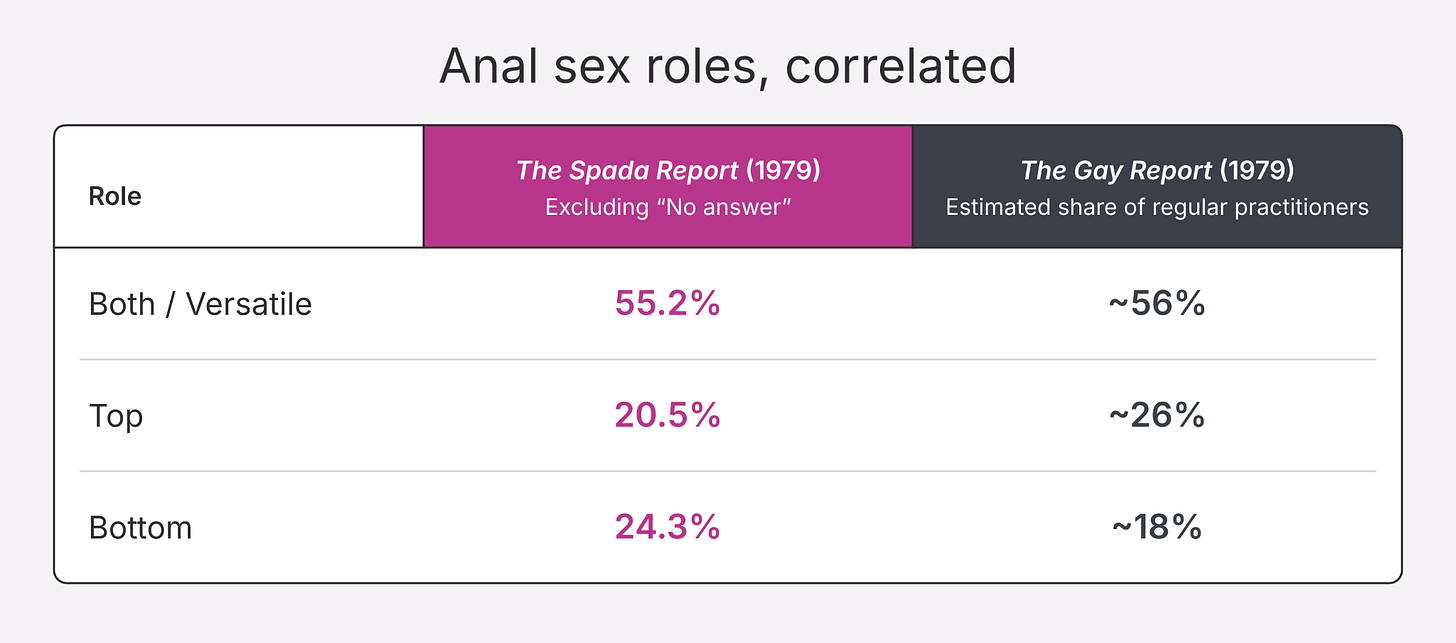
An example of the methodological difference is their questions about roles (top, bottom or versatile) in anal sex. Spada asked what respondents usually do—something closer to “what position do you identify as”—while Jay and Young separated topping and bottoming into two separate frequency scales. So they get more nuanced, interesting data, but no clean answer to the question I most wanted answered, which was What percentage of gay men are vers?, a product of my long bafflement with anyone who disagrees with the obviously correct proposition that a majority of gay men are vers. The raw results of the two questions look like this:
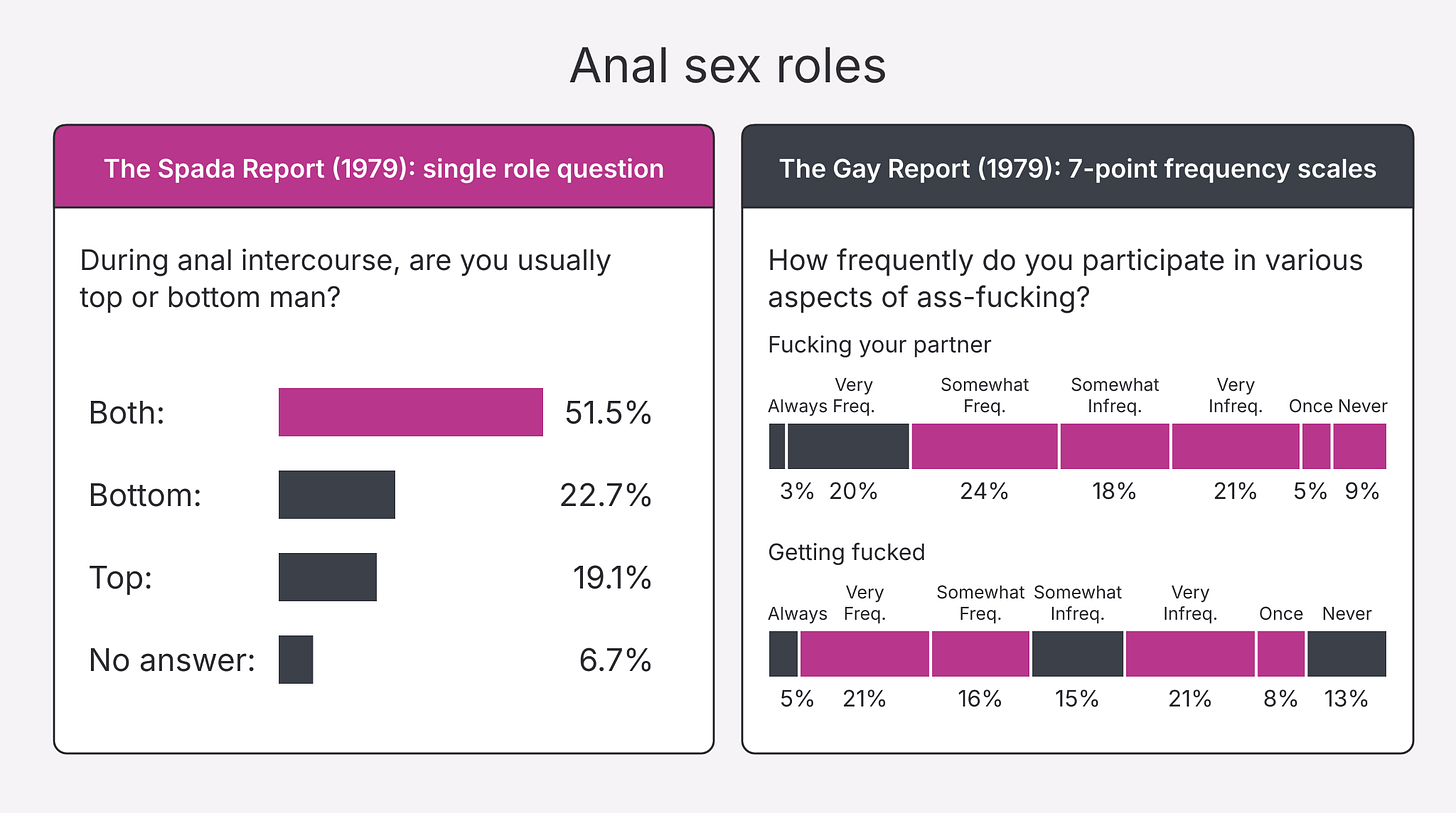
Purely in terms of sociological best practice, The Gay Report’s question is better. “Usually” is a slippery word that leaves a lot of room for subjective interpretation, poor memory, and wishful thinking. The Likert scales invite the respondent to think more precisely about what they actually do. But “better” also depends on what you want to know; more precise data doesn’t always answer less precise, more fun questions like What percentage of gay men are vers? Since this is an example of asking a similar question different ways, AI can do a little bit of math and give us an estimate of the Gay Report’s data to prove me right:
Relationships, non-monogamy, and ‘promiscuity’
In other cases, however, the two studies asked questions that touch on a similar question, but with such a different focus that it’s difficult to correlate them so directly. A good example is relationship status and non-monogamy. Both surveys were deeply interested in gay men’s emotions about love, affection, and relationships, but Spada asked more direct questions about feelings about relationship status and non-monogamy. He asked, first of all, whether his respondents currently have, or, if they don’t, if they want a lover:
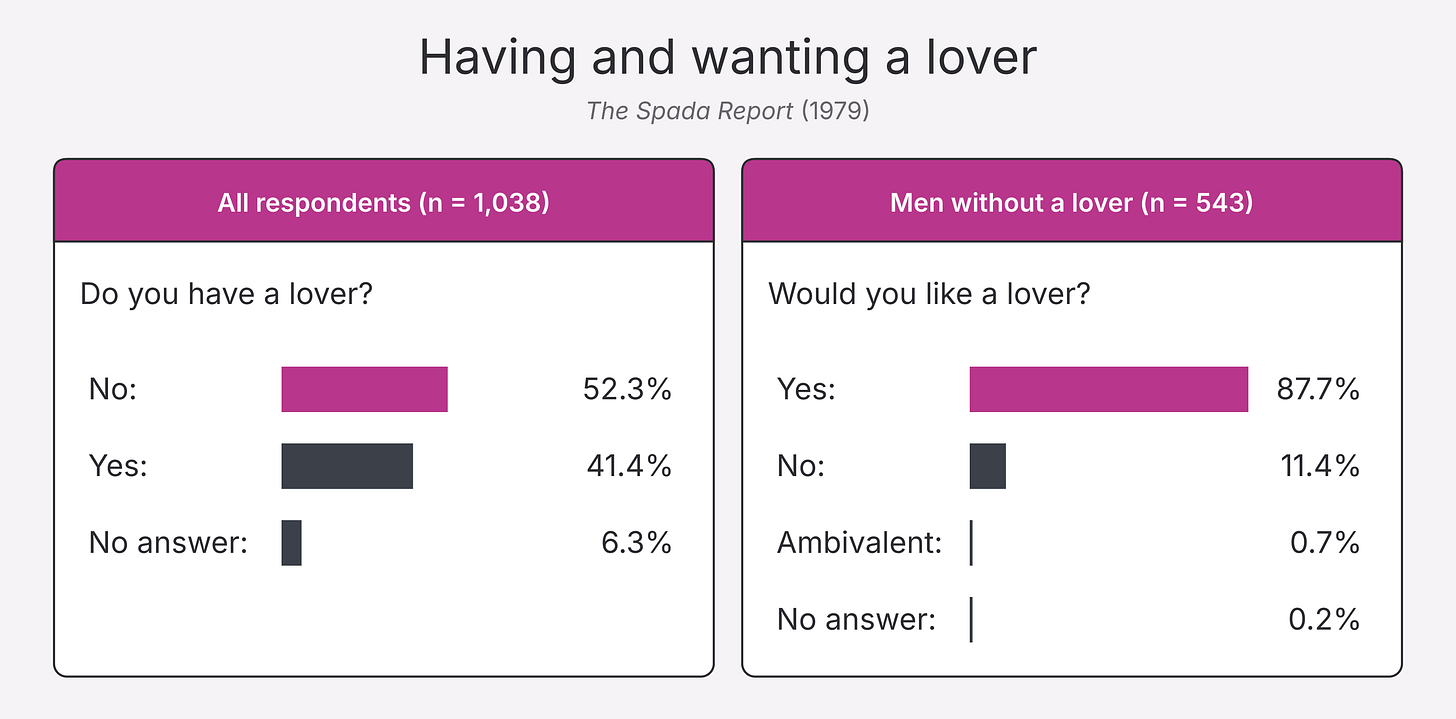
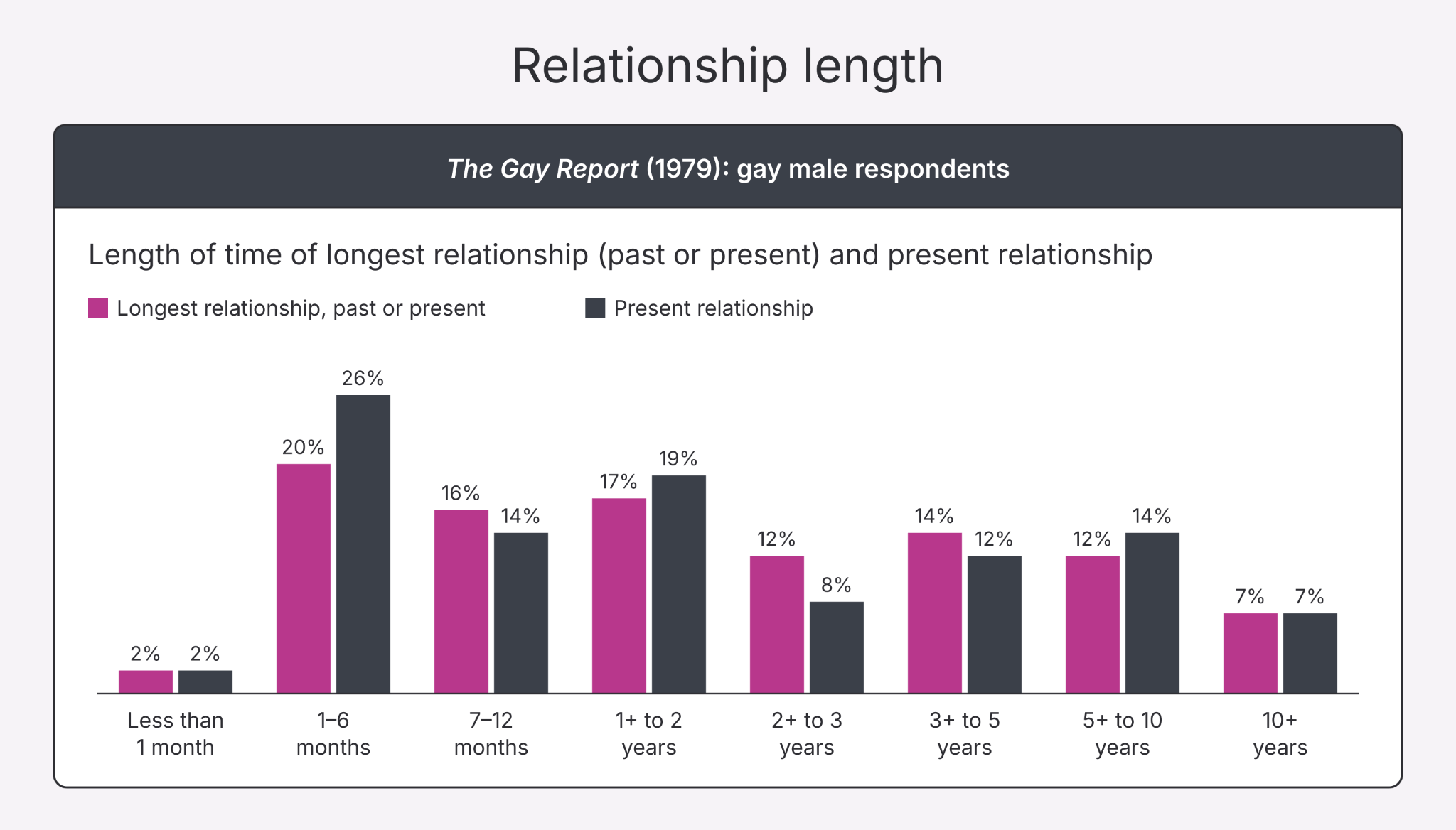
Usually Jay and Young are more nuanced about gaps between what people do or have and what they would like to do or have, but here it was Spada—thinking about stereotypes and the political context, we might imagine—who thought to ask whether more gay men want relationships than currently have them. The Gay Report asked simply about the length of respondents’ longest and current relationship. The data this question generated is characteristically more fine-grained and equally revelatory, throwing some cold water on the idea popular at the time (both inside and outside the gay world) that gay men couldn’t form lasting relationships:
It’s hard to say Jay and Young are uninterested in the questions of either couples or non-monogamy, as they quote from the qualitative responses on the subject in several different chapters. On the other hand, it does seem a bit odd, in 1979, to ask a question like “How do you feel about the idea of gay marriage?” but not “Do you and your lover have sex outside your relationship?” This is speculation, but it’s possible, given their negative editorial comments about marriage in the book, that their self-consciously radical perspective—which at the time often meant sex-positivity and opposition to the couple form—shaped their (relative) inattention to relationships.
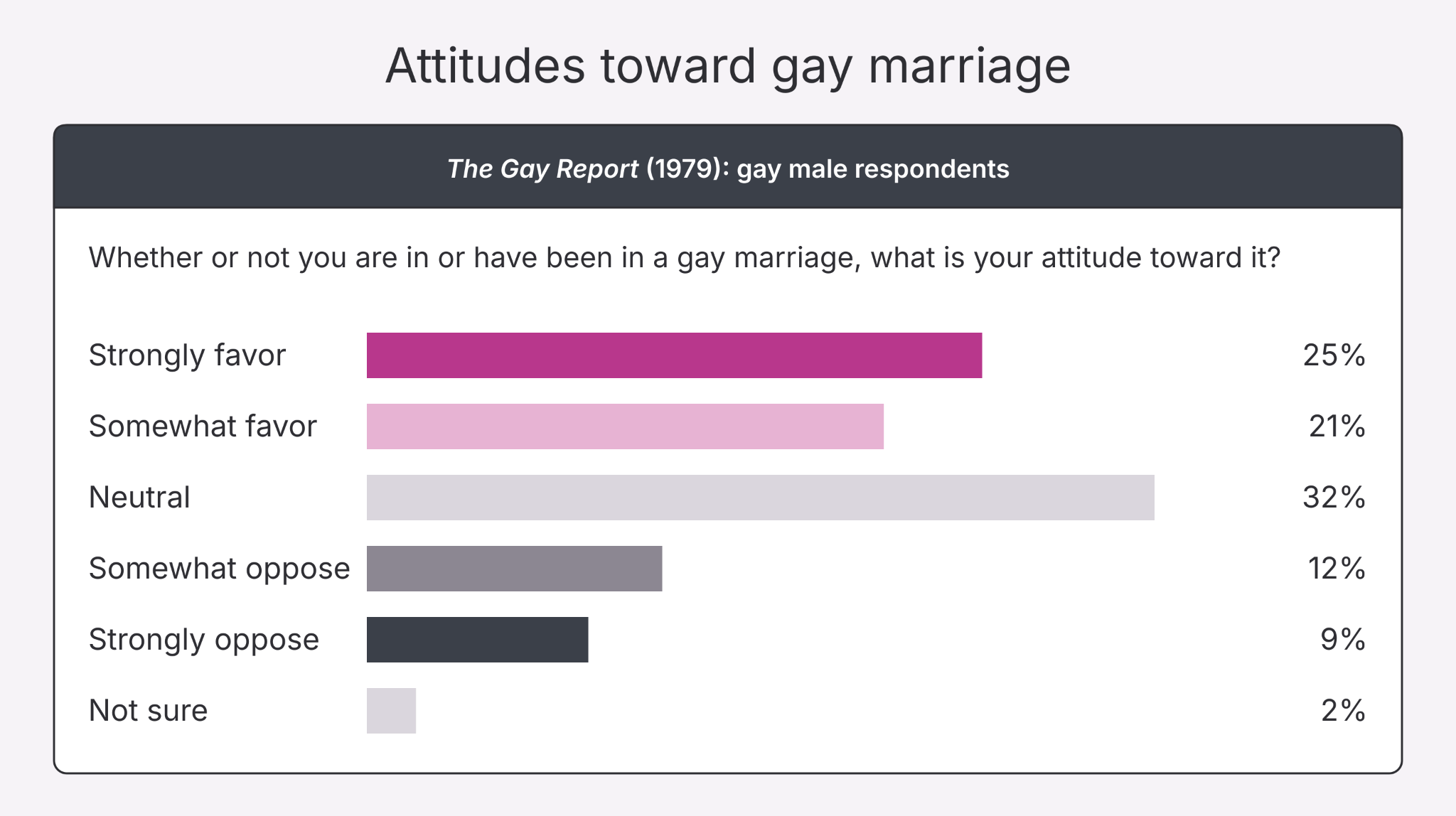
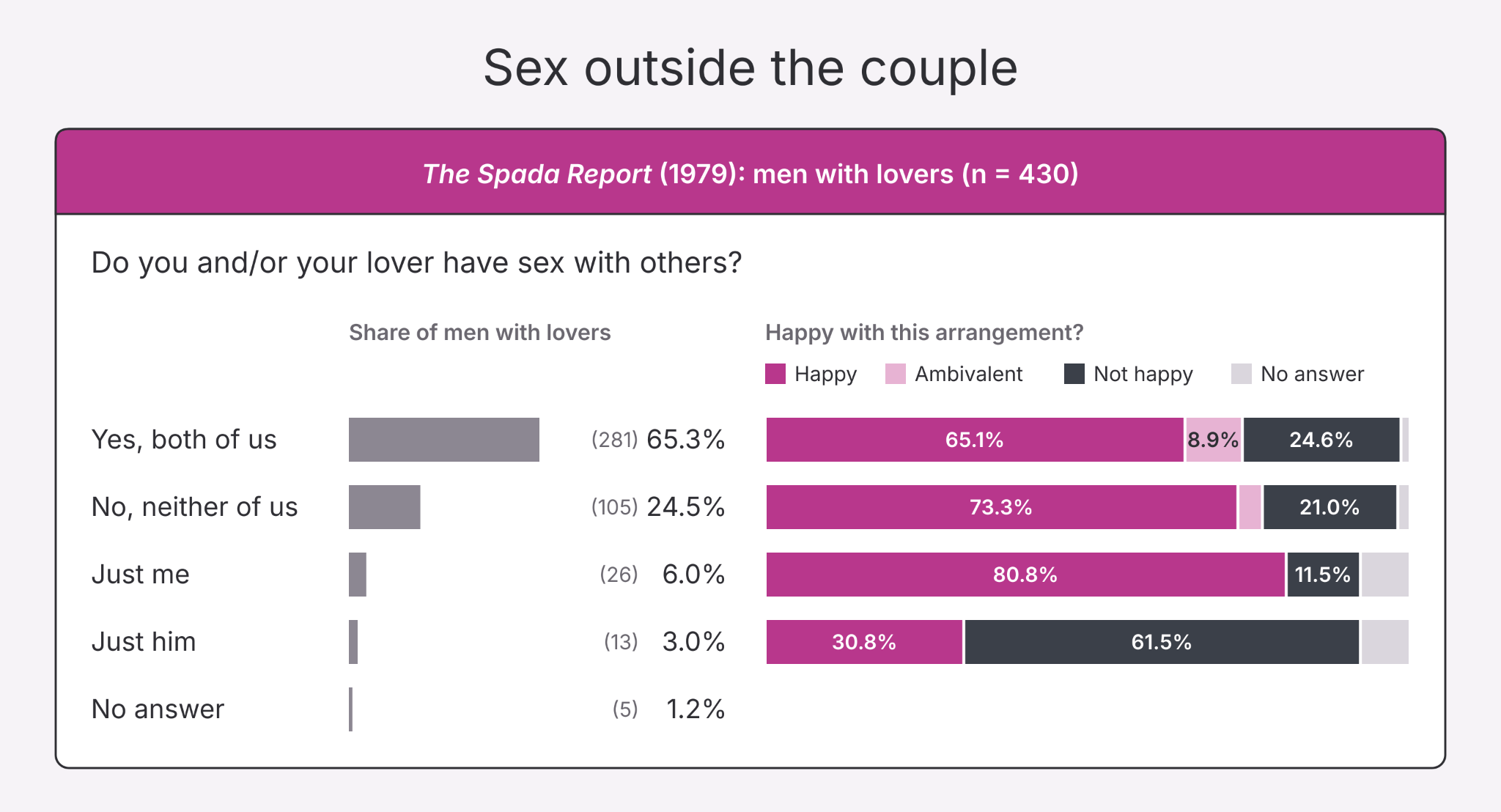
It’s similarly possible that Spada being in a happy relationship himself shaped his questions. As he told the Advocate, he and his partner, Dan, were “basically monogamous” but sometimes slept with other people without it being a big deal. He agreed with his respondents who thought “that monogamy is a very artificial constraint to put on a relationship,” but also commented, “I don’t believe that two people who are lovers should go out every night to different bars. If they do, why bother being lovers?” Try capturing that in a survey question! Anyhow, Spada wins for this question not only about non-monogamy but also the ingenious “are you happy with it” breakout for each category:
Even though Spada was asking questions about relationship non-monogamy, it occurs to me that our framing of that issue has perhaps shifted from a general question of “promiscuity” in the 70s to debate focused on non-monogamy vs. monogamy. After all, Andrew Holleran and many others could be ambivalent about “fast-food sex” in the late 70s without counterposing it to “we have food at home” sex or ever being in a significant relationship himself. The Gay Report has a section on “promiscuity”—“one of the more controversial aspects of gay male social patterns”—with detailed questions about numbers of sex partners within different time frames and “one-night stands.”
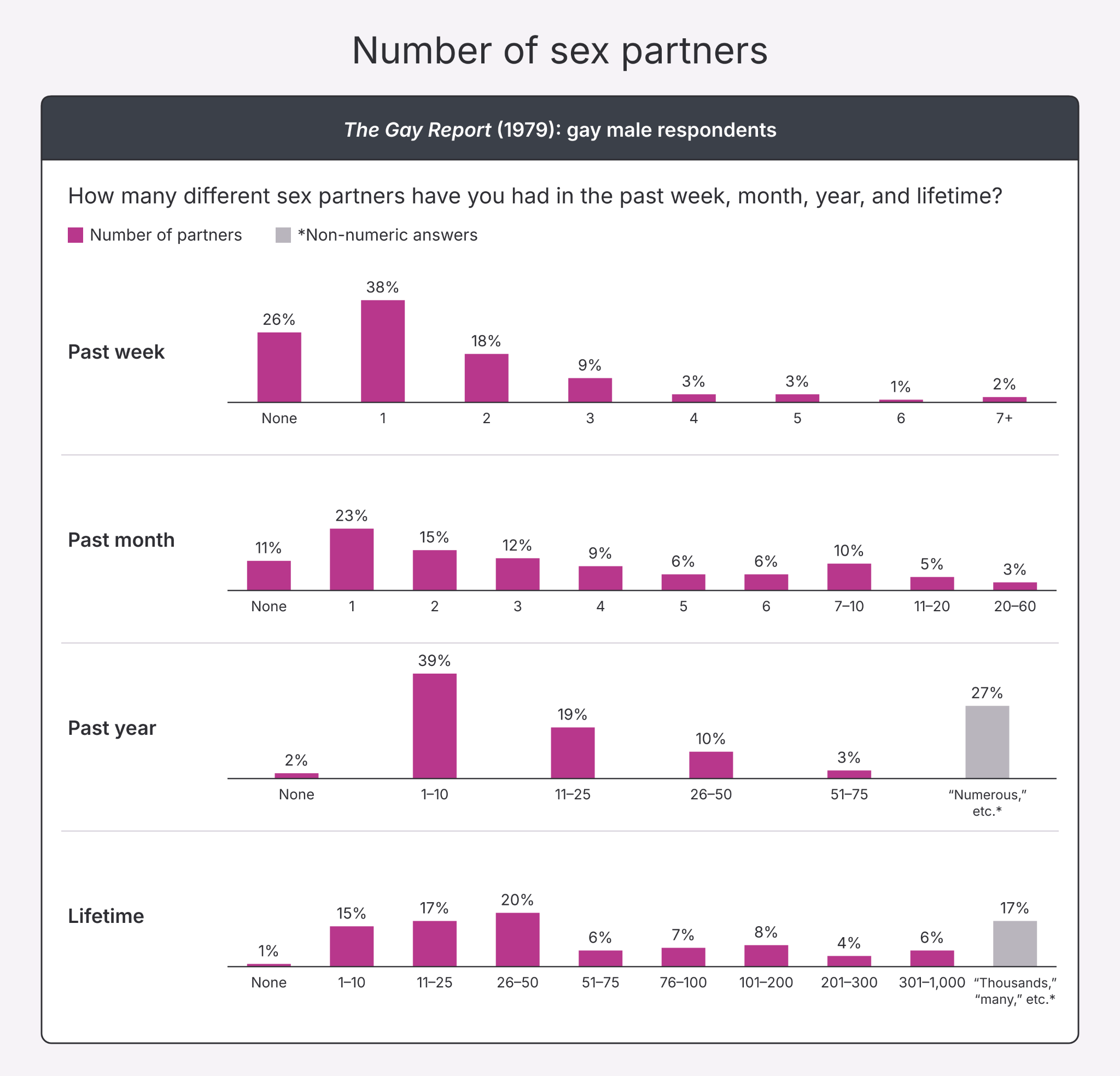
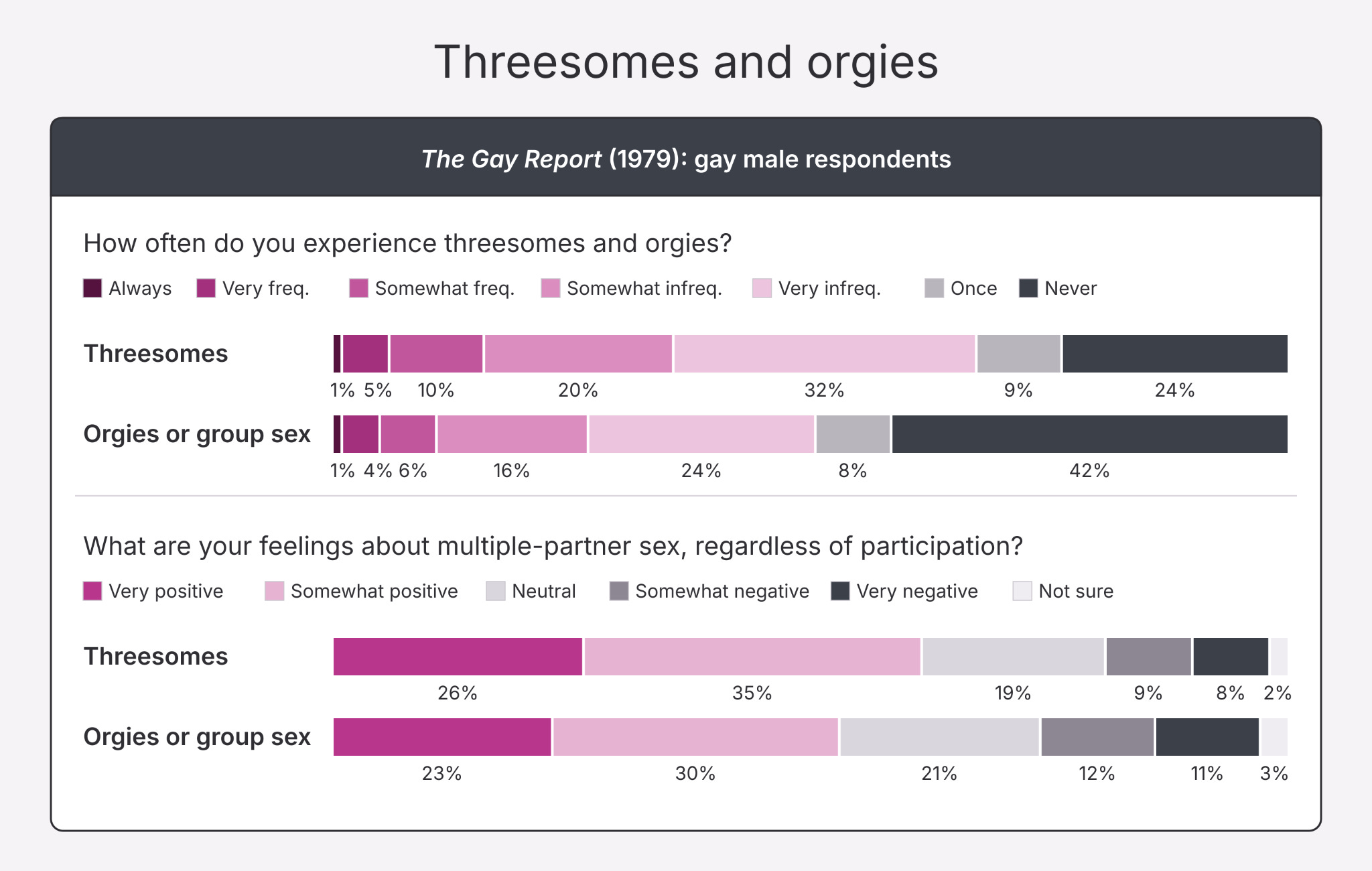
Jay and Young’s chapter on kink has also a section with detailed questions about different types of group sex. In both of these chapters, the respondents bring up their relationship status in their qualitative answers, but none of the structured questions actually ask about it. We can assume a significant portion of these questions were answered by men in relationships of different monogamy status, but they unfortunately only give us indirect comparisons with Spada. They do, however, sound about right to me, and broadly consistent with survey data on promiscuity collected more recently.
To round it out the sex part with another unique Spada question, this also seems about right:
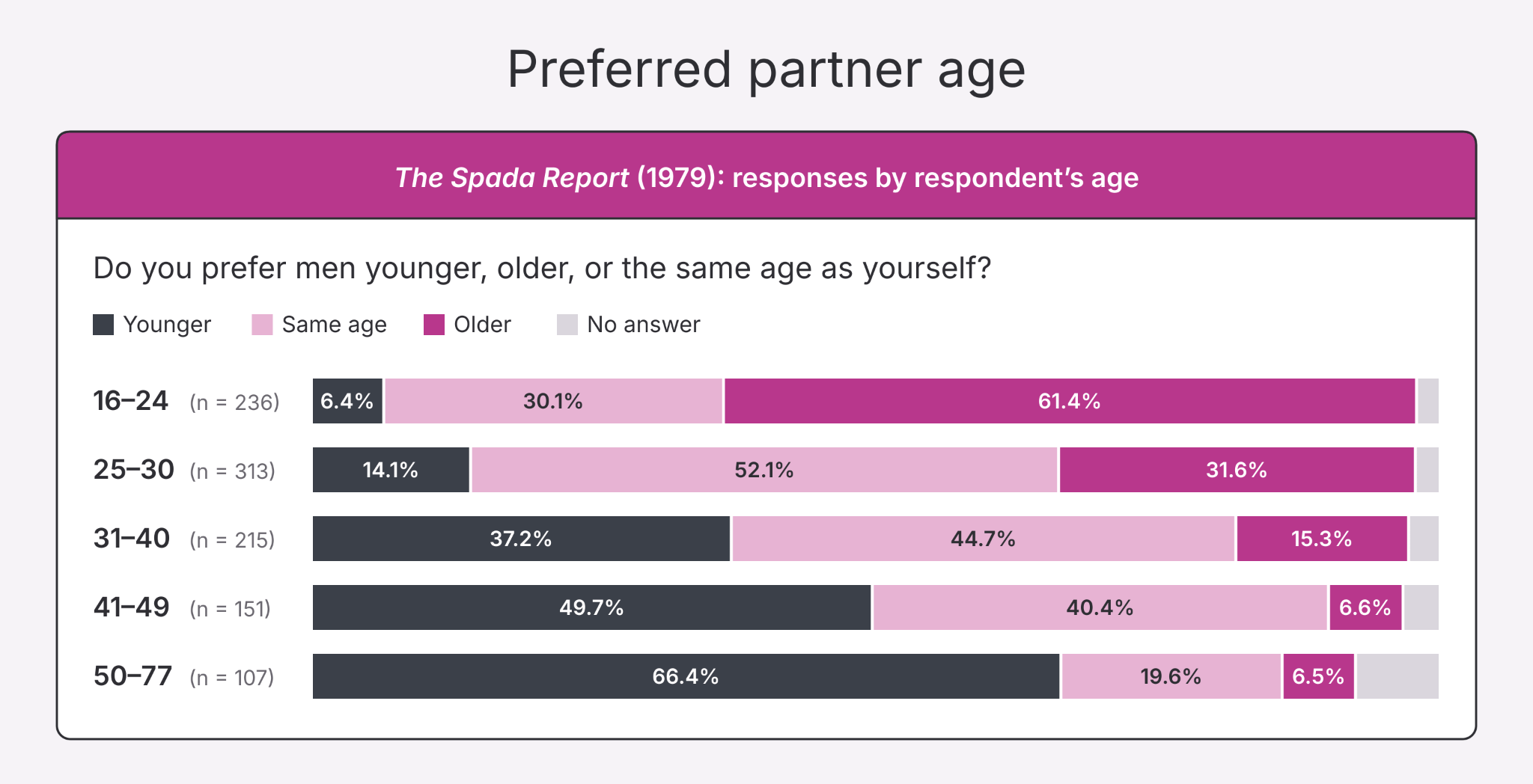
Masculinity, drag, and camp
All three authors saw gay liberation as challenging the dominant culture’s gender roles and stereotypes. “Gay men are first of all victims of macho straight culture in America in which women are secondary citizens,” Spada said of his respondents’ negative comments about lesbians (more on that below). And yet, both surveys found a fairly strong identification with at least some notion of masculinity. The respondents, for example, universally reject dressing in women’s clothing, either for themselves or their sex partners, though The Gay Report’s respondents were almost equally positive about “very masculine” clothing (53%) as “colorful, stylish or unisex” clothing (52%).
This obviously doesn’t mean a straightforward attachment to stereotypical or straight masculinity. Spada asked, “How would you define masculinity?”, a question that unsurprisingly produced such diverse responses that they couldn’t be coded. There are many responses of the most stereotypical sort—identifying it with male physical traits, mannerisms, or even “being straight”—but also denunciations of “gay macho” and wishes to do away with the concept altogether. “A new concept of masculinity emerges from the replies which follow, one that has little to do with America’s traditional ideas on the subject,” Spada writes, a bit optimistically. “Many of the men see masculinity primarily as ‘being yourself,’ stating that feeling secure about who and what you are is masculine.”
The gender-presentation questions were surely shaped by their historical moment. In the late 1970s, what were formerly major aspects of gay culture came to be associated with pre-Stonewall oppression; drag and camp, in particular, were thought to be dying out. The rise of “gay macho” seems to have gone hand in hand with ambivalence or even hostility toward drag queens. “We don’t hate ourselves as much,” wrote Edmund White, summing up the 70s, “but I do wish everyone would stop picking on drag queens.” Considering what would happen later—drag lived on and became one of the primary vehicles for the mainstreaming of gay culture—this question is, as much as any, a snapshot of its time.
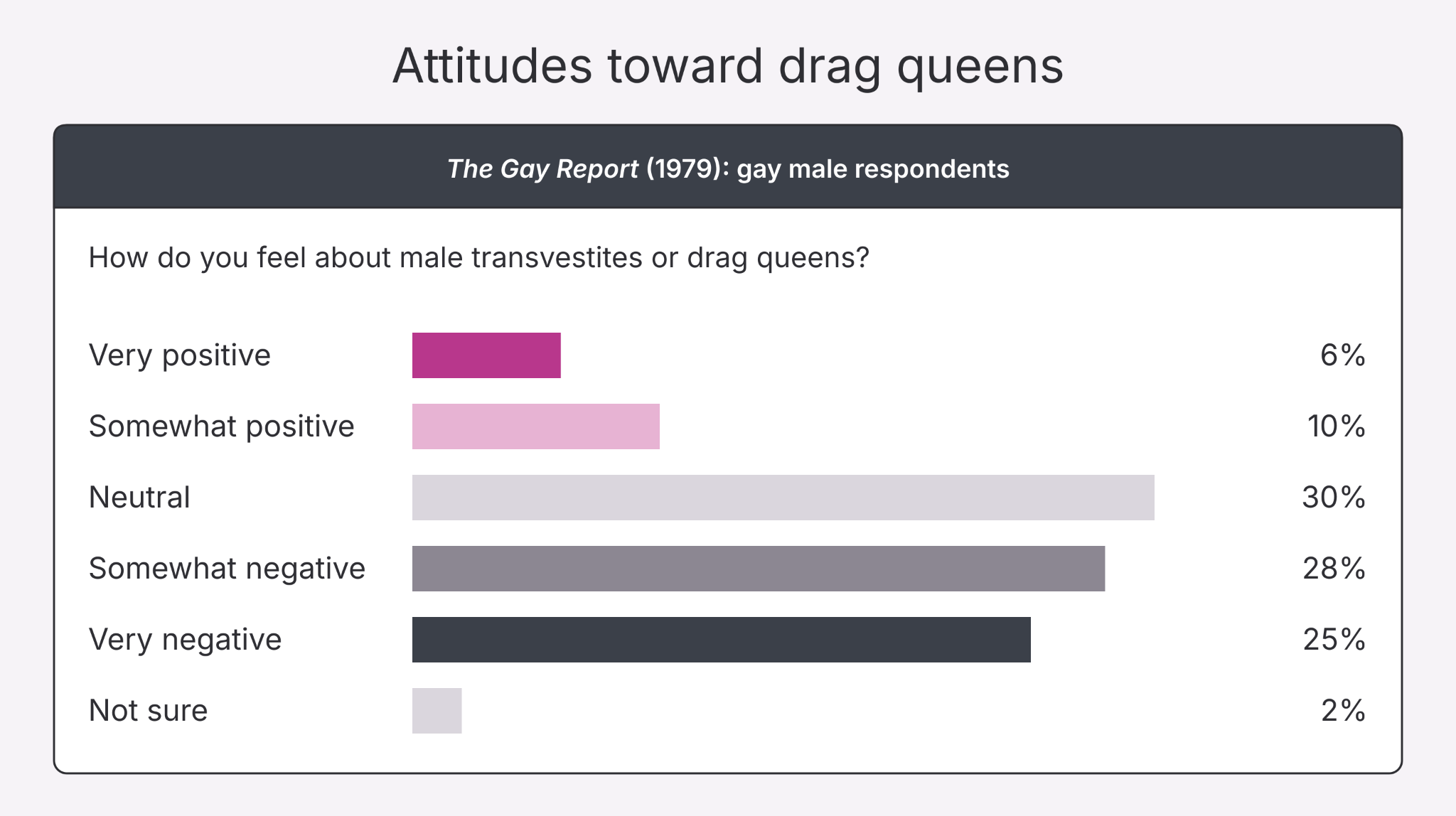
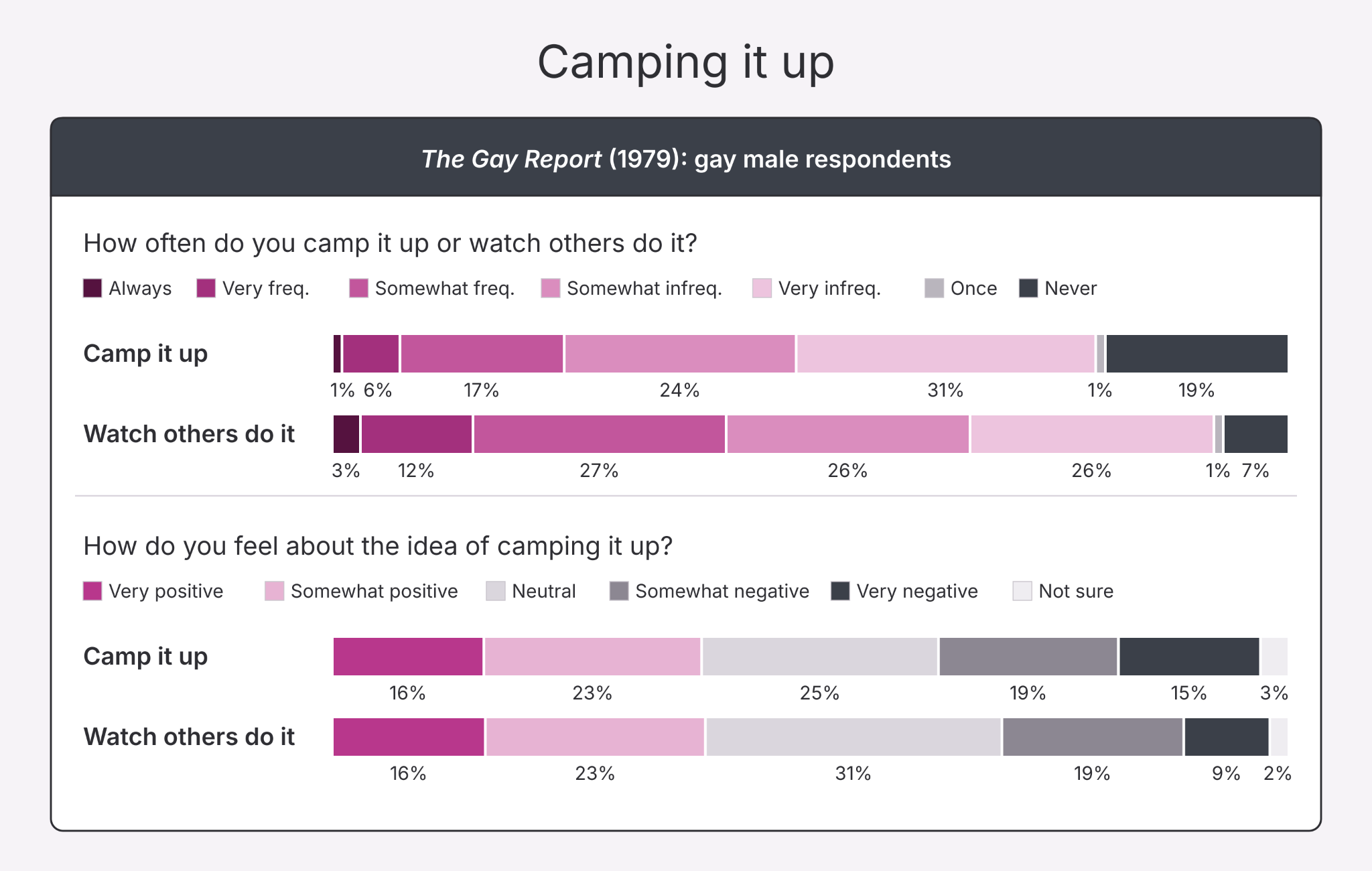
Though some gay intellectuals, like a few of Spada’s respondents, tried to paint the new gay masculinity as politically reactionary, and even to associate it with “fascism,” it did not really do away with camp. As writers like White noticed at the time and the sociologist Martin Levine later argued, the gay “clone” preserved and transposed elements of camp, and as should have been clear from the existence of the Village People, gay masculinity itself could be a kind of drag. All of which makes the responses to the The Gay Report’s question about “camping it up” interesting: on the one hand, an overwhelming majority acknowledged “camping it up” at least occasionally (80%), while feelings about it were more ambivalent:
Lesbians
Despite being a solo male author and less associated with the gay left than Jay and Young, Spada asked far more questions about gay men’s perceptions of women. His question about lesbians, and the significant minority who expressed negative views about them, drew attention from interviewers.
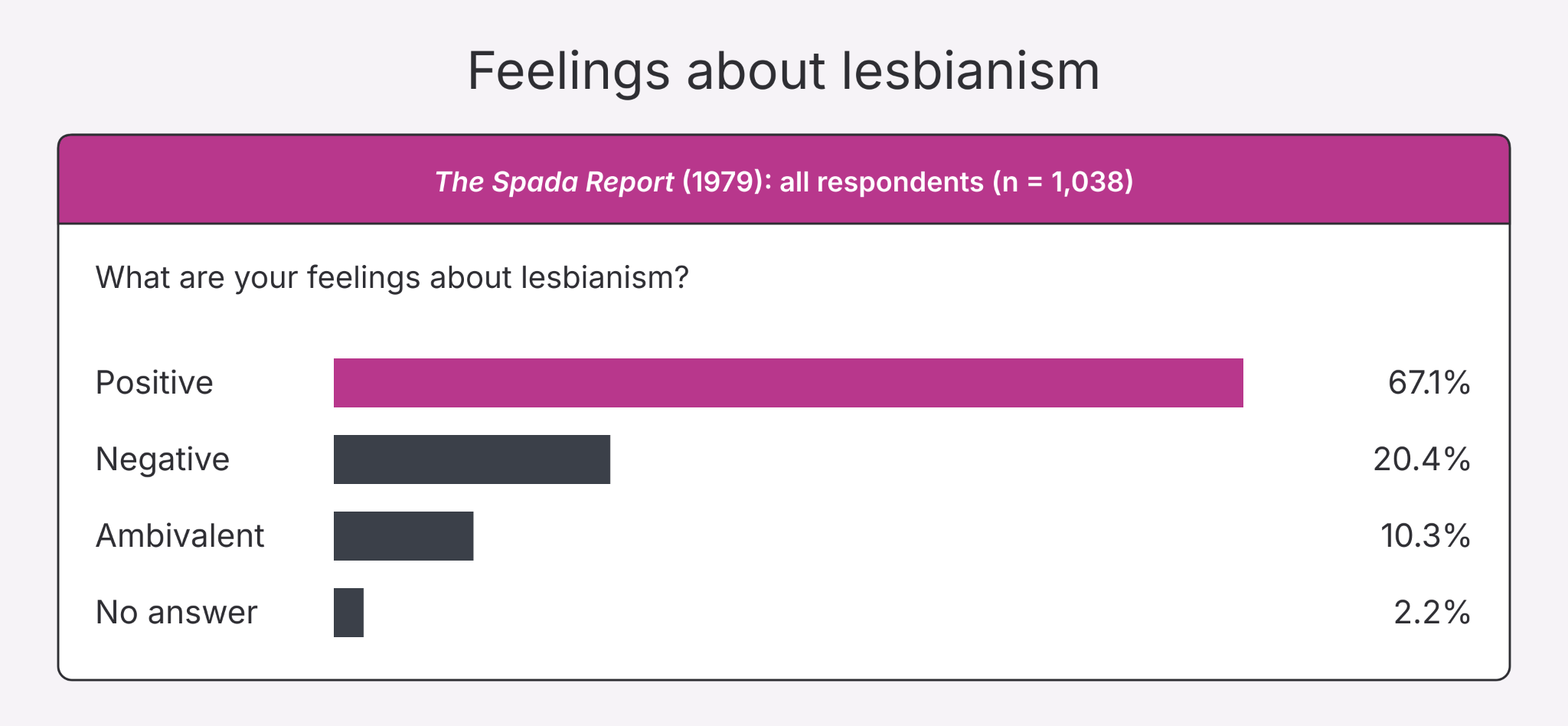
I chose this one because of how all over the place the qualitative responses are. Of course, a large majority of Spada’s respondents (67%) had positive views of lesbians. They saw gay men and lesbians as having a lot in common, desired political unity, wanted a less sex-segregated gay life, or said they felt more comfortable with lesbians than straight women. But many of the qualitative responses expressed some incomprehension toward lesbians regardless of whether they were coded as “positive” or “negative,” and even respondents in the “negative” bucket often stressed that they supported rights for lesbians as much as their own despite their personal dislike. The negative responses are darkly amusing for their confessions of ignorance and bafflement, or just straight-up admission of prejudice. And more than a little fear:
“I feel alienated about lesbianism because I don’t know shit about it.”
“Two penises are better than one. None is simply inconceivable.”
“I guess I’m a little afraid of them. Their masculinity is rarely toned down by the gentleness of a bona-fide man.”
“I subconsciously loathe and feel threatened by lesbians, even though politically I support their rights.”
“I don’t like their masculinity (I don’t like feminine men, either), and they scare me. They’re too tough.”
The authors of The Gay Report suggested an explanation for these feelings of incomprehension based on their questions to both groups about who they most often socialize with: “The group that gay men are most separated from, perhaps ironically, is lesbians, though that may be a reflection of the fact that both gay men and lesbians frequently socialize in their own special environments, while both play straight in straight settings.”
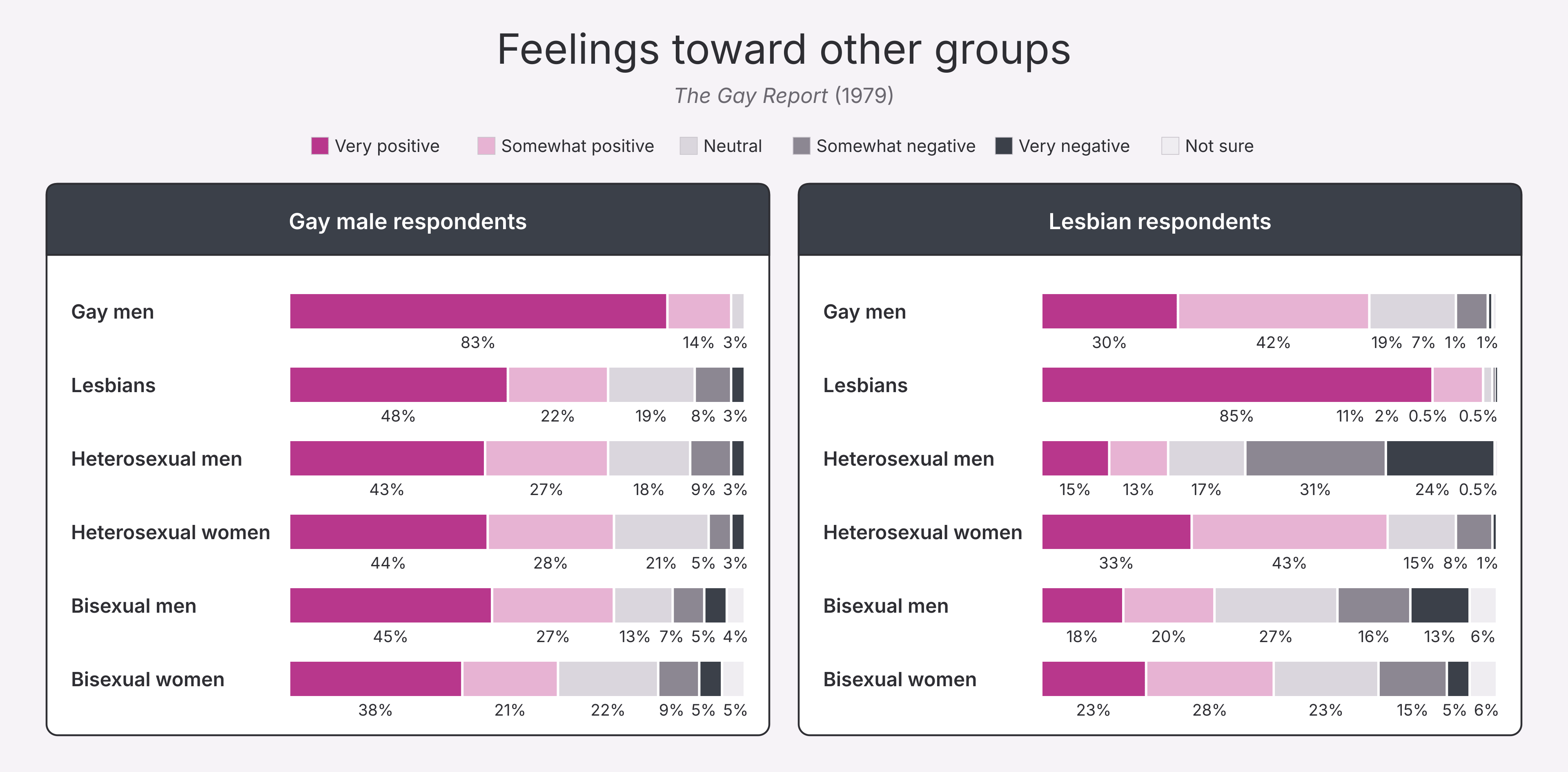
Jay and Young asked gay men and lesbians their feelings about each other, but also about people of other sexual orientation and gender combinations. They notably found similar degrees of ambivalence/negativity toward the other group in each (around 30%), but less outright negative gay feelings about lesbians than Spada. Interestingly, though, they also found significantly fewer lesbians had “very positive” feelings about gay men (30%) than the other way around (48%):
I have only really scratched the surface here, especially of The Gay Report, whose 800+ pages have an almost staggering amount of detailed, fascinating data. That alone would make it worth picking up a used copy to browse through. But in my next post, I will suggest that the real pleasure of these books lies in the qualitative responses, which, as the authors intended, allowed gay people to describe themselves in their own words.
James Spada, “A Gay Writes His Father of His Happiness,” Los Angeles Times, June 24, 1977.
Christopher Stone, “Spada Lets Gay Men Speak for Themselves,” The Advocate, December 14, 1977.
Alan Bell and Martin Weinberg’s Homosexualities used more rigorous sampling methods and more structured interviewing techniques, but drew its subjects entirely from the San Francisco area.
Jay and Young made an impressive effort to distribute their questionnaire through a wide range of gay, lesbian, and straight left-wing publications and mailing lists, as well as at gay conferences and institutions like bars and movie theaters. But over half of the responses came from an abridged version published in the gay skin magazine Blueboy.
J. Lee Lehman and James M. Saslow, “A Rap With ‘The Gay Report’ Reporters,” The Advocate, June 14, 1979. The book was in some ways two parallel research projects: Jay and Young separately developed the questionnaires for and wrote the chapters on women and men, respectively, and broke out the responses separately even in the joint chapters on topics like oppression, politics, and gay culture. More lesbians than gay men seem to have objected to the inclusive scope; the authors reported that a few lesbian separatists “attacked Karla for working with a man” and for “inviting men into lesbians’ bedrooms and giving information to the ‘enemy.’” She responded that there was nothing to keep straight men from buying a book entirely by and about lesbians, as she had witnessed them doing in lesbian bookstores.
Brent Harris, “Spada Speaks: A Rap With the Reporter,” The Advocate, July 26, 1979; The Spada Report, 3.