


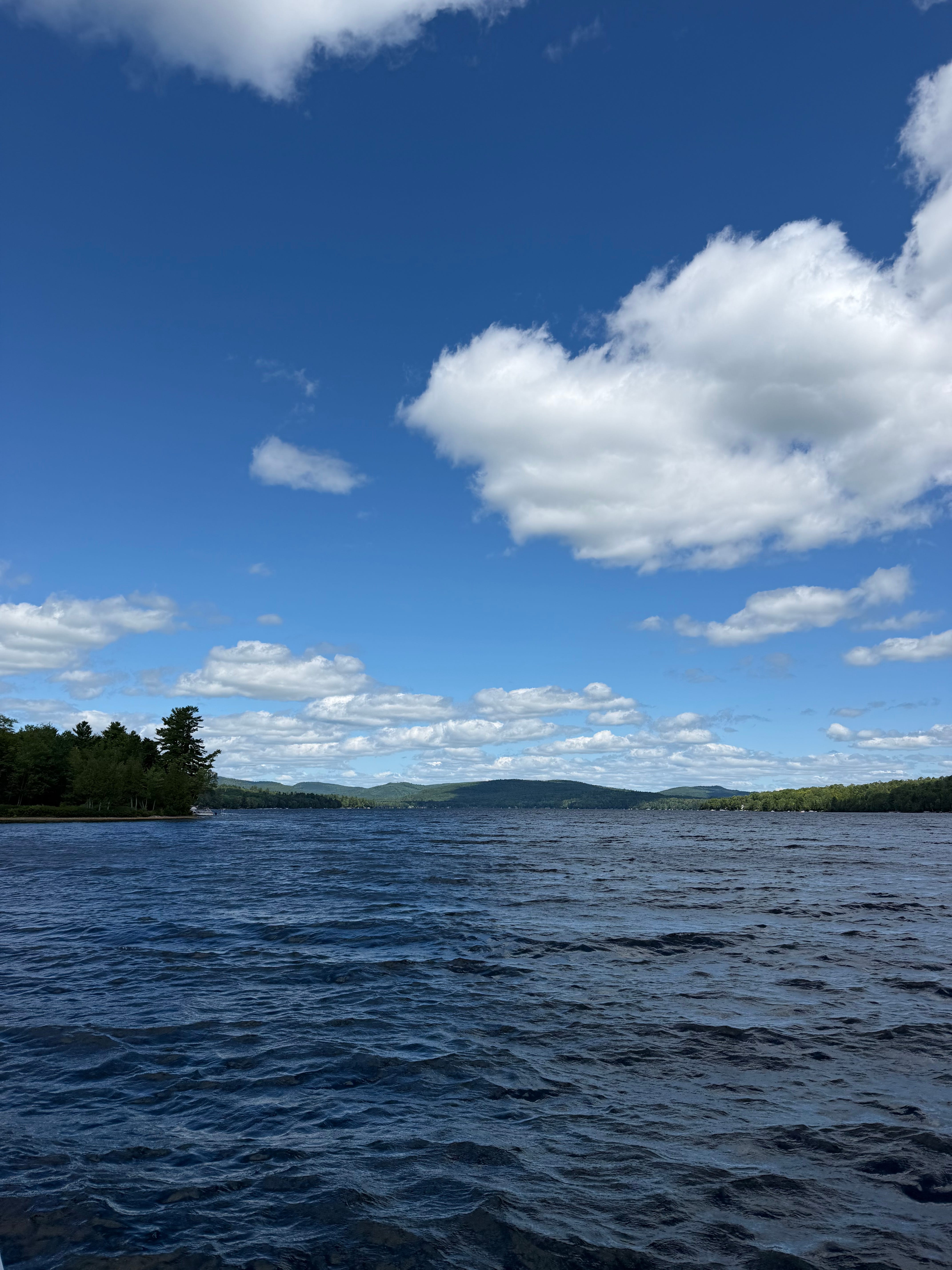
I’m looking out over Embden Pond in central Maine, where I’ve spent a week the past few summers. I’m always the first one up; I like looking out in the morning from the screened-in porch to see the sun on the water. I can’t see the clouds for the treetops, but I can follow the giant, charcoal smudges that crawl across the green mountainsides on the far side of the lake and then slide over the surface toward me. I always have this thought whenever I’m trying to describe the natural world: why is it normal for painters to have to look at things in order to picture them, while writers have to make it up in their heads? Has a writer ever, like, taken a notebook out to the beach and tried to write down what they see?
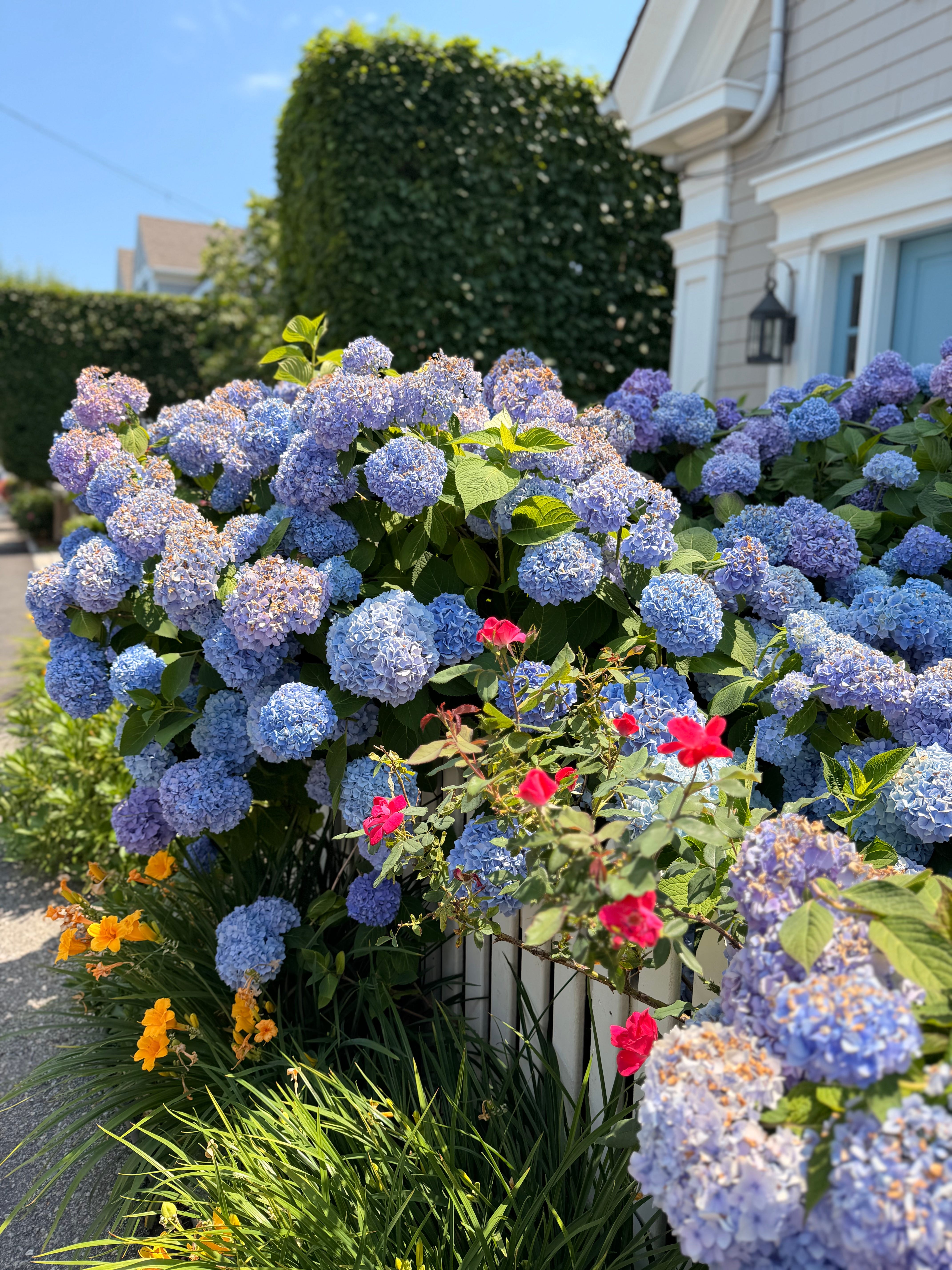
I’ve realized that one of the best resolutions one can make is to do exactly the same thing every year. Not everything, but some things, the big things. That way you never have to decide again if you’re going to do that thing or something else; after my fifth consecutive summer charade of “I’m sick of Provincetown, I need to do something else this year,” not finding something else to do, getting to Provincetown and realizing, seeing again the fiery sunset in the hydrangeas, “Oh, right, I always come back here because it’s absolutely stunning,” I’ve decided to stop pretending and just accept that I’m going to Provincetown every year, that there is no need to feign interest in diversifying my travel destinations. No need to improve upon the already perfect.
When you do the same thing every year, you experience the pleasure of repetition, of anticipating emotions and sensations you’ve had before, and which have a greater weight for recurring at a designated point in a familiar sequence. As always, in Maine I gather the intimations of fall: the cool mornings and evenings, the smell of fire and the taste of bacon from cast-iron that reminds me of deer hunting trips when I was a boy. I begin to feel the outlines of the season that follows the bright, slack days of late August, when work and ambition return.
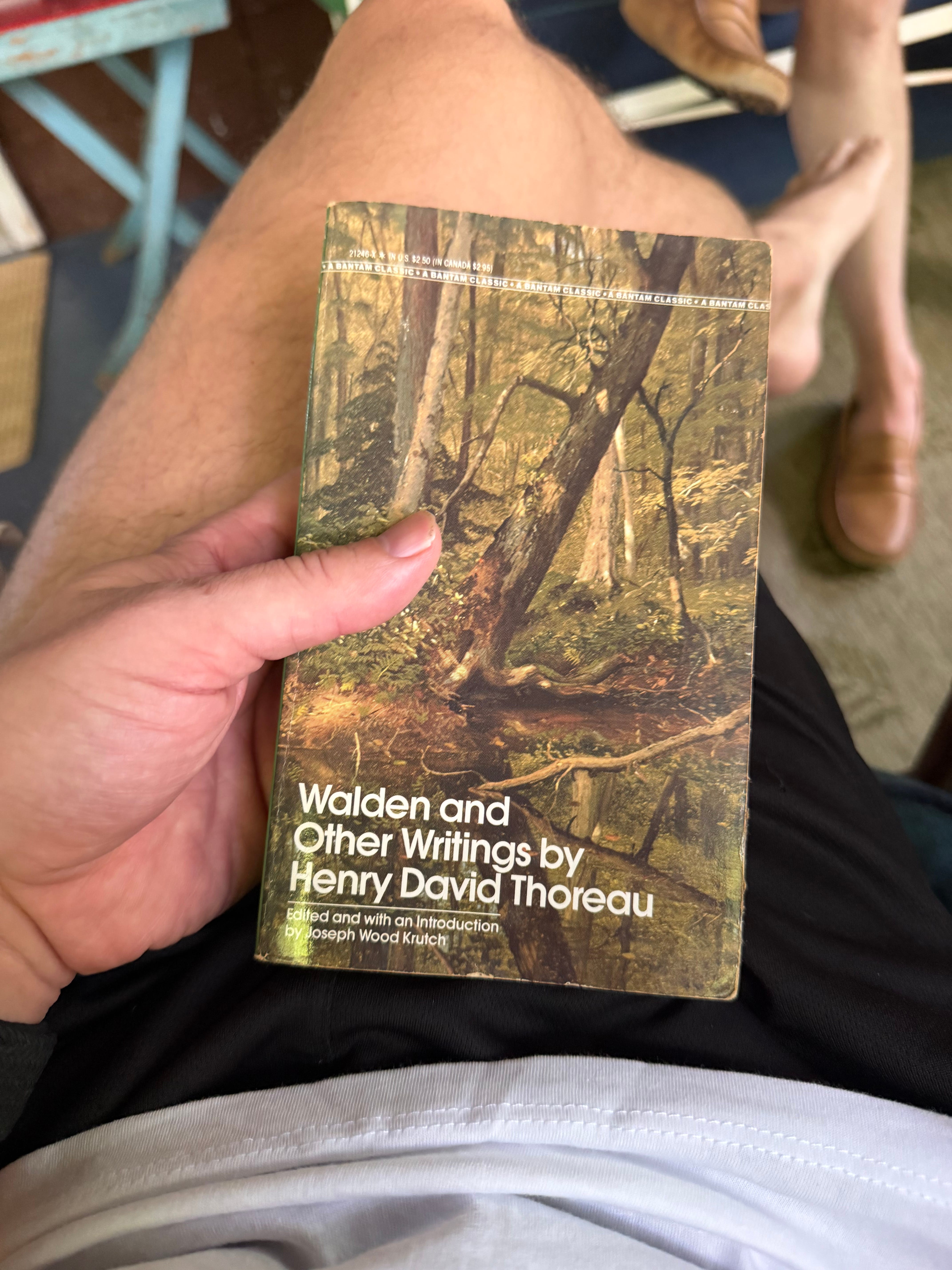
But repetition is the condition of possibility of difference; I also notice the variation. The one in the group who yaps at me in the morning when I’m trying to write has not come this time. This year, as opposed to last year and the year before and the year before, I am actually, truly not in love with Situationship anymore. I mostly wasn’t last year, but now I’m not at all. What I feel for him now is an affection that no longer has anything to do with me, the kind that remains after all the fantasies and projections have burned themselves out and what’s left is only the real person. It still has something of the shape of that old, yearning ache, but not the ache itself; it has twisted, in the past year, from a residual pain into a pleasure. When you do the same things every year, the instances begin to blur into one—it begins to feel that you were in Provincetown so many times that you never left—and they also become a measure of evolution, even of progress.
In 2024, on the bank of the pond just around the bend from our cabin this year, I read Dancer from the Dance for the second time. I laughed at the part in the opening chapter where Malone gets sentimental about the sleepy, picturesque town of Sayville, where they transfer to the ferry to Fire Island:
“Why don’t we take a house here next summer instead?” But he knew we wouldn’t, and he knew he wouldn’t, for even now the drums were in our blood, we sat forward almost hearing them across the bay, and the van raced on through the streets so that the driver could hustle back for another load of pleasure-seekers, so bent on pleasure they were driving right through Happiness, it seemed, a quieter brand of existence that flourished under these green elms. We kept driving right through all the dappled domesticity, like prisoners, indeed, being moved from jail to jail imprisoned in our own sophistication.
Two years ago I read that after the annual week in Provincetown and thought about how every year I say the exact same thing, It’s really such a beautiful town! We really should come here some other week and do something besides—general gesture in the general direction of the hectic events of July 4th week—all this. I never did that until this year, and when I read Dancer again this year I remembered all the white-picket-fence reveries in the rest of the novel and better understood how sentimental that scene is supposed to be, that scene I took two years ago to be straightforward. Evolution, even progress.
Jason arrives from Boston and his forehead is flaming even though he told me he hadn’t had fever for two days. I kiss him anyway. Only four months and already three days without him felt like torture. I immediately have him drive me to Walmart because, as usual, I feel trapped and bored out of my mind in Nature. I love nature but will never pretend to have any kind of mystical connection with it; anyone who imagines they feel such a thing forgets that they learned it from books. They are not feeling some sort of natural resonance but rather inserting themselves into a secondhand fantasy, a fantasizing tradition. Our streak of miserable logistical luck continues. I didn’t bring a physical credit card and Walmart doesn’t accept payment by tap or Apple Pay because they have their own “wallet” system. I type in my card number from a saved photo on my phone, but it is rejected due to a “security error”; the machine says it “cannot read chip” in Jason’s physical card. All this the week after I had to rebook a flight for the next morning after I went to the airport without an ID. I begin to understand the appeal of fantasies of a world not pointlessly overlaid with technology.
The other momentous thing one can resolve is never to do something. I decided, for example, that I am never going to read Bret Easton Ellis, despite French people being obsessed with him, despite the recommendations of people I like. I tried again, I read the book descriptions again, but I just can’t. Cynicism and alienation are the polar opposites of my affective makeup. I hate violence, especially when writers think it is transgressive, deep, or morally significant. People who think criticizing consumerism is interesting are generally morons. Yes, Ellis is supposedly gay, sort of, but clearly has no real interest in it. I am not going to like it, and as of today am not going to waste any more time trying to talk myself into it.
Instead I read Allen Barnett’s story, “The Times As it Knows Us,” which Blake recommended weeks ago but I rediscovered yesterday by accident, having had Barnett on my reading list but forgetting he was the author of that particular story. It’s about a group of gay friends on a summer trip to Fire Island, half of whom are dying of AIDS or fear they’re coming down with it, and all of them angry with one of the group who talked to a New York Times reporter for a story about how gays on Fire Island are coping with the epidemic. Blake told me about it because I had been thinking about this very phenomenon, the way that gay social relations constitute themselves in reference to the New York Times, both obsessed over and resented. I had tried to write a sociological piece, ultimately unpublished, about how Provincetown metabolized Matthew Vines’ controversial Times op-ed about “gay vs. queer” the weekend of July 4th. There are too many characters in Barnett’s story to keep track of or for them to really have distinct personalities, but there’s a touching subtlety in his attention to relational dynamics that is something different than Holleran’s stylized projections. In Dancer there are so many groups of friends on Fire Island, but they’re all part of an interchangeable mass, all a Symbol, whereas Barnett’s characters are actual people.
An actual person, what Situationship is now that he’s no longer a character in the novel of my life, refusing to play the role I wrote for him in my head. In Maine he becomes himself. He loves seeing his dogs; they squeal with delight when he gets out of the car. He says almost nothing the entire week, but at night he calls to the loons and they answer.
He is awake now; I hear him stumble around the cabin for a few minutes, then he stands over me, glowering wordlessly, until I realize I’m wearing his sweatshirt. Now he’s out on the dock below; the late-morning sun makes his golden hair and golden skin look the exact same color. The wind is high now, hoisting the branches and whipping at the surface of the lake as if against the direction it wants to move, breaking its ripples into whitecaps. Not the linear, rhythmic kind one sees in the ocean, but scattered, random ones that blink in and out against the dark water. The scene is strenuous, aggressive, and the sound of the wind is a relentless roar, but if you squint the movement of the whole looks like a kind of sparkling.